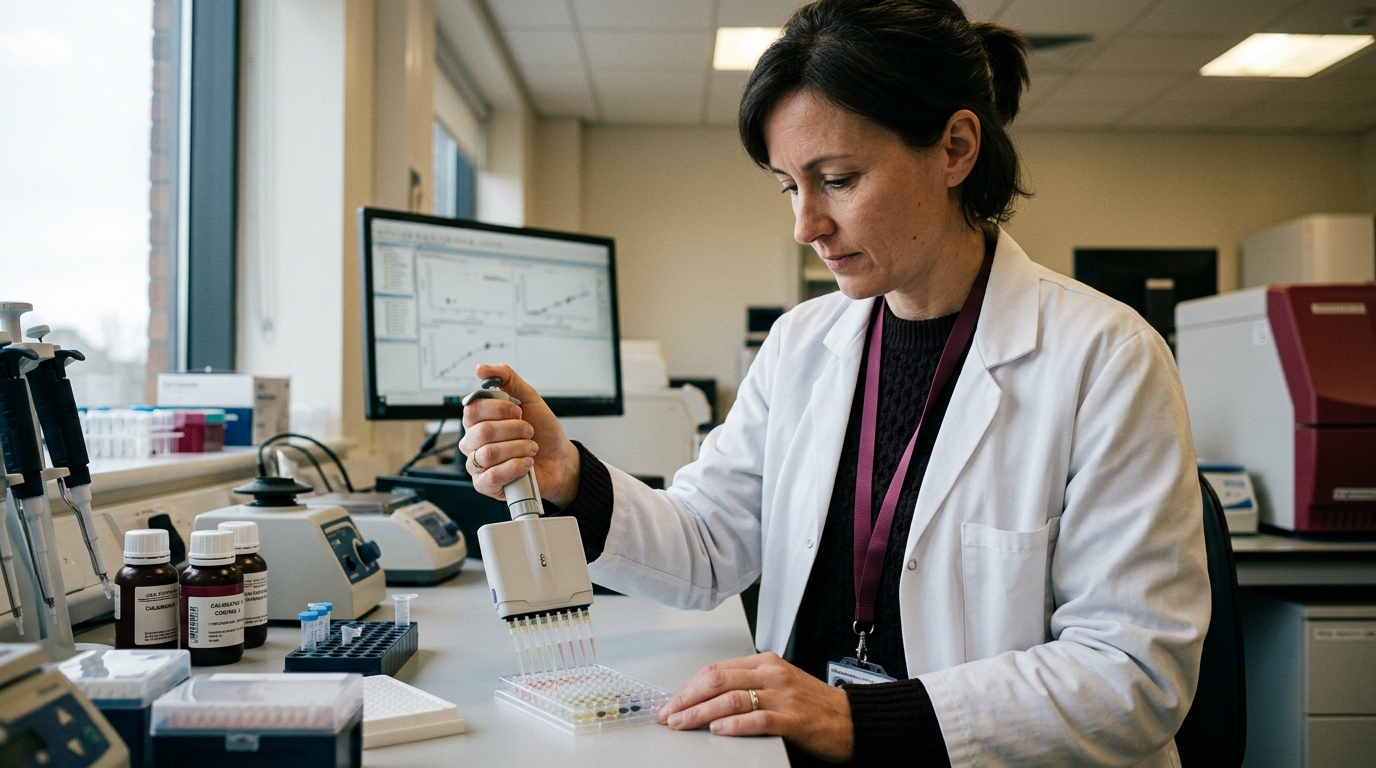

Accurate hormone tracking allows you to evaluate long-term testosterone trends effectively by standardizing blood collection conditions, laboratory assays, and relevant clinical symptoms.





Tracking testosterone is not simply a matter of plotting isolated numbers on a graph to see if they go up or down. A true comparison framework evaluates whether two or more laboratory tests were conducted under comparable physiological and analytical conditions.
When you evaluate hormone levels over months or years, you must consider the clinical question being asked, your symptoms, the time of blood collection, whether you were fasting, the specific laboratory assay used, and your overall health status. Without this context, normal day to day biological fluctuations or minor differences between testing platforms can easily be mistaken for meaningful physiological shifts.
This guide outlines a structured, evidence-based method for recording, organizing, and comparing serial hormone results. It explains why consistent testing parameters are essential, how different treatment formulations alter testing schedules, and why biochemical trends must always be interpreted alongside clinical assessment by a qualified medical professional.
The information provided in this article is for educational and informational purposes only. It is not intended as medical advice, diagnosis, or treatment. Hormone evaluation, laboratory testing interpretation, and treatment decisions require individualized assessment by a qualified healthcare professional who can review your complete medical history, physical symptoms, and clinical findings. Always consult a physician or licensed healthcare provider before making changes to any medication, testing routine, or health regimen.
Tracking hormone levels over time involves comparing serial laboratory results against consistent baseline parameters. A single lab report provides a snapshot of circulating hormone concentrations at one specific minute in time. In contrast, longitudinal tracking attempts to identify whether a biological pattern is stable, declining, or responding as expected to medical treatment.
To track hormone results accurately, you must first separate the distinct clinical questions that a blood test can answer. Conflating different testing goals leads to flawed interpretations and unnecessary worry.
The first clinical question is whether an untreated individual has consistently low testosterone levels accompanied by physical symptoms. Clinical guidelines from the American Urological Association state that a diagnosis of testosterone deficiency requires both low total testosterone concentrations and compatible symptoms or signs.
The guideline uses a total testosterone cutoff below 300 ng/dL, which is equivalent to below 10.4 nmol/L, as a reasonable supporting threshold. Both the American Urological Association and the Endocrine Society recommend confirming this cutoff with at least two separate morning measurements. In this initial stage, tracking simply determines if low values are persistent or transient.
The second clinical question applies to men who are not receiving hormone therapy but want to monitor their endocrine health over time. A man might alter his sleep schedule, change his exercise habits, or undergo medical treatment for an unrelated condition.
When comparing tests over months or years without hormone therapy, the goal is to assess whether natural biological shifts have occurred. This requires that every repeat test strictly mirrors the baseline collection conditions. If a follow-up test is drawn at noon while the baseline was drawn at 8:00 a.m. any observed difference reflects daily circadian rhythms rather than a change in baseline endocrine function.
The third clinical question applies to individuals who have been prescribed testosterone replacement therapy. In this context, blood testing is used to verify that circulating levels are reaching therapeutic targets without exceeding safe physiological thresholds.
Treatment monitoring introduces unique variables, particularly the timing of blood collection relative to when the medication was administered. A blood draw taken three days after an injection answers a completely different clinical question than a draw taken twelve days after an injection. Tracking during therapy requires detailed documentation of dose, formulation, and administration times.
You can learn more about how diagnostic standards are structured by reading about testosterone testing and biomarkers across different clinical settings.
A common pitfall in hormone tracking is treating the laboratory value as the sole determinant of health. Laboratory assays measure physical concentrations of chemical molecules in blood serum, but they do not measure how your body responds to those molecules.
Both the American Urological Association and the Endocrine Society explicitly state that laboratory values alone do not constitute a diagnosis. A man with a total testosterone level of 280 ng/dL who has no physical symptoms, normal energy, healthy sexual function, and normal bone density does not meet the clinical criteria for hypogonadism. Conversely, a man with severe fatigue and erectile dysfunction whose total testosterone sits at 310 ng/dL requires comprehensive clinical evaluation rather than immediate dismissal.
Clinical context also requires identifying the root cause of any observed deficiency. The Endocrine Society recommends measuring luteinizing hormone and follicle-stimulating hormone once low testosterone is confirmed. These pituitary hormones help distinguish between primary hypogonadism, where the problem originates in the testes, and secondary hypogonadism, where the problem originates in the pituitary gland or hypothalamus.
Tracking should also document changes in overall physical health. Shifts in body weight, new medications, changes in blood pressure, chronic inflammatory illnesses, and high stress levels can all influence endocrine output. A comprehensive tracking system records these health events alongside numerical lab values.
For a broader understanding of how symptoms interact with lab results, see our guide on evaluating low testosterone.
To make serial hormone results truly comparable, you need a systematic method for recording laboratory and clinical data. Simply storing PDF lab reports in a folder makes it difficult to spot analytical discrepancies, such as changing units or varying assay methods.
When building a personal comparison record, ensure that you track the following specific fields for every blood draw.
Preserving the original values, units, and reference ranges prevents misinterpretation. If you choose to plot your results digitally, keep the raw laboratory report linked to every data point.
Circadian biology exerts a substantial influence on circulating hormone levels in men. In healthy young and middle-aged men, testosterone production peaks during sleep and reaches its highest circulating concentration in the early morning hours. Levels gradually decline across the afternoon and evening, reaching a trough before sleep begins again.
Because of this daily rhythm, standard clinical practice requires diagnostic testing to be performed during the biological morning peak. Clinical reviews generally advise drawing blood between 7:00 a.m. and 11:00 a.m.
Comparing a blood sample collected at 8:00 a.m. with a sample collected at 3:00 p.m. will almost certainly show a decline. That drop reflects normal human biology rather than endocrine failure. If your work schedule or daily routine changes, you must account for these timing shifts when interpreting results.
Shift workers represent an important clinical exception to standard morning testing windows. A person who works overnight and sleeps from 8:00 a.m. to 4:00 p.m. has an inverted circadian cycle.
For these individuals, drawing blood at 8:00 a.m. captures the biological evening trough rather than the morning peak. While general clinical guidance notes that shift workers require individualized timing, standard laboratory protocols do not offer a single universal clock time for non-traditional schedules. You should discuss your specific sleep and wake schedule with your clinician to determine the most appropriate window for repeat draws.
Even when blood is drawn at the exact same minute under identical fasting conditions, your testosterone level will not be identical from one day to the next. Human hormone secretion is pulsatile and influenced by daily physiological demands.
Scientific research investigating within-person hormone variation shows that day to day biological variation contributes significantly more to total test variance than analytical laboratory error. In studies analyzing repeated hormone measurements, the difference between two separate blood tests in the same individual exceeded 18% to 28% roughly half the time.
Because of this natural fluctuation, researchers concluded that a single blood sample is generally insufficient to characterize an individual's true baseline hormone status. However, ordering more than three samples to establish a baseline is rarely necessary in routine clinical practice. Understanding this natural variability helps you avoid overinterpreting minor changes between consecutive tests.
To understand the core biological mechanisms governing these fluctuations, review our overview of testosterone fundamentals.
A major source of confusion when comparing hormone results comes from differences in laboratory technology and reporting standards. Two different blood tests drawn on the exact same morning can yield different numbers if processed by two different laboratories using distinct testing platforms.
The Endocrine Society highlights that non-standardized assays can cause the exact same blood sample to be classified as low by one laboratory and normal by another. To address this issue, international standardization programs, such as the Centers for Disease Control and Prevention Hormone Standardization Program, work to harmonize steroid assays across commercial facilities.
Laboratories typically measure total testosterone using either automated immunoassays or liquid chromatography tandem mass spectrometry. Automated immunoassays are widely available and cost effective, but they can suffer from cross-reactivity with other circulating steroid molecules.
Liquid chromatography tandem mass spectrometry is considered the reference standard for steroid hormone quantification due to its superior accuracy and sensitivity, especially at lower hormone concentrations. When tracking results over time, check your laboratory reports to see which methodology was utilized. Whenever possible, the American Urological Association recommends using the same laboratory and measurement method for repeat diagnostic assessments.
Hormone concentrations are reported in different units depending on your geographic region and the specific laboratory chosen. In the United States, total testosterone is conventionally reported in nanograms per deciliter (ng/dL). In Canada, the United Kingdom, and Europe, laboratories typically report values in nanomoles per liter (nmol/L).
The standard diagnostic threshold of 300 ng/dL corresponds to approximately 10.4 nmol/L. When comparing tests from different providers, always confirm the unit printed on the page. Never convert units in your head without recording the original reported value and unit in your tracking log.
Every laboratory report includes a reference interval printed alongside your numerical result. These intervals are established by testing a reference population of individuals and calculating the statistical range that covers 95% of healthy results within that group.
Because reference populations, demographic filters, and assay platforms differ between commercial labs, reference ranges vary. One laboratory might report a reference range of 264 to 916 ng/dL, while another reports 300 to 1,000 ng/dL.
A result of 280 ng/dL might be flagged with an "L" for low on one report while falling within the normal interval on another. This reinforces why clinical guidelines emphasize standardized numerical thresholds and clinical symptoms rather than automated laboratory flags.
Total testosterone measures all circulating testosterone in your bloodstream, including hormone that is tightly bound to proteins and hormone that is freely available to tissues. However, total testosterone alone does not always provide the full clinical picture. Several complementary biomarkers help clinicians interpret your results accurately.
Sex hormone-binding globulin is a glycoprotein produced by the liver that binds tightly to circulating testosterone and estradiol. Approximately 44% to 60% of circulating testosterone is bound to sex hormone-binding globulin, rendering it biologically inactive for immediate tissue uptake.
Conditions that alter sex hormone-binding globulin concentrations will directly alter your total testosterone concentration without necessarily changing the amount of active hormone reaching your tissues. For instance, obesity, insulin resistance, type 2 diabetes, and hypothyroidism can lower sex hormone-binding globulin levels. Conversely, aging, hyperthyroidism, liver disease, and caloric restriction can raise sex hormone-binding globulin levels.
Free testosterone refers to the roughly 1% to 3% of circulating testosterone that remains completely unbound to proteins. Bioavailable testosterone includes free testosterone plus testosterone that is loosely bound to serum albumin, which can easily dissociate to enter target cells.
The Endocrine Society clinical guidelines state that clinicians should assess free testosterone whenever sex hormone-binding globulin concentrations are altered or when total testosterone concentrations are borderline near the lower diagnostic limit.
However, the method used to determine free testosterone is critical:
When tracking free testosterone over time, always record whether the value was directly measured by equilibrium dialysis or calculated from binding proteins. Never compare a calculated free testosterone value directly against a direct analog immunoassay result.
Luteinizing hormone and follicle-stimulating hormone are peptide hormones released by the anterior pituitary gland to regulate testicular function. Luteinizing hormone stimulates Leydig cells to synthesize testosterone, while follicle-stimulating hormone supports spermatogenesis.
Tracking these gonadotropins provides essential diagnostic context:
Albumin is the most abundant protein in human plasma and binds loosely to testosterone. Measuring albumin ensures accurate mathematical calculation of free testosterone levels.
Prolactin is another pituitary hormone that may be evaluated when secondary hypogonadism is suspected. Significantly elevated prolactin levels can suppress gonadotropin release and warrant further neurological or endocrine investigation.
When you begin testosterone replacement therapy, standard morning fasting rules shift. Instead, sample timing must be coordinated around your specific medication type, dose, and administration schedule.
A blood sample drawn at an arbitrary time during a treatment cycle can result in misleading clinical decisions. For example, testing too close to an injection shows an artificial peak, which might prompt an inappropriate dose reduction. Testing too late captures a trough, which might lead to an unnecessary dose increase.
Major endocrine guidelines outline specific timing recommendations for different treatment formulations.
Short-acting esters, such as testosterone cypionate and testosterone enanthate, create a peak in circulating hormone levels followed by a steady decline over several days.
Daily transdermal gels are absorbed through the skin, establishing relatively stable daily concentrations after steady state is reached.
Transdermal patches deliver a continuous dose of hormone through the skin over a 24-hour period.
When starting therapy or changing a dose, initial follow-up testing is typically conducted after 3 to 6 months to evaluate response and safety. Once stable therapeutic levels are established, the American Urological Association recommends monitoring serum testosterone every 6 to 12 months.
Treatment tracking must also evaluate safety biomarkers alongside hormone levels. Follow-up blood work routinely includes a complete blood count to monitor hematocrit and red blood cell production, as well as prostate-specific antigen testing when clinically indicated.
To learn more about long-term clinical protocols, explore our section on testosterone therapy monitoring.
When reviewing serial lab reports, distinguishing between normal analytical variability and a genuine physiological trend is essential. A change of 30 ng/dL between two tests rarely represents a true shift in health.
To determine whether a trend is meaningful, consider three major factors: biological variation, acute lifestyle disruptors, and the consistency of collection conditions.
Every blood test contains two types of variability:
Because biological variation is naturally high, small shifts between tests are entirely normal. If your total testosterone moves from 420 ng/dL in January to 380 ng/dL in June under identical conditions, this change reflects normal human variance rather than endocrine decline.
Lifestyle factors are frequently blamed for sudden drops in testosterone, but scientific evidence shows that their effects are nuanced and often misunderstood.
Sleep duration is a prime example. A comprehensive systematic review and meta-analysis of 18 clinical studies found that total sleep deprivation, where individuals were kept awake for an entire night, significantly reduced circulating testosterone levels. However, short-term partial sleep restriction did not show a statistically significant reduction across the pooled data.
Furthermore, controlled experimental studies in healthy young men undergoing severe acute sleep restriction or mild chronic restriction found no significant changes in hormone levels under specific testing conditions. While chronic sleep apnea and long-term health disruptions certainly affect hormones, an isolated night of poor sleep before a blood draw does not automatically explain away a low laboratory result.
Other acute factors, such as intense endurance exercise within 24 hours of testing, acute viral illnesses, severe caloric restriction, and high alcohol consumption, can transiently alter hormone output. Documenting these events in your log helps your clinician determine if a retest is necessary.
For evidence-based guidance on health habits, read our analysis of lifestyle factors affecting hormones.
To understand how this framework functions in real-world scenarios, consider the following illustrative comparison models. These patterns highlight how collection variables change clinical interpretation.
When presenting your serial tracking records to your doctor, focus on collaborative, clinical questions. Structured questions help your physician interpret your data efficiently.
Consider raising the following points during your consultation:
You can compare them broadly, but you must do so with caution. Different commercial laboratories often use different testing platforms, chemical reagents, and reference intervals. Whenever possible, clinical guidelines recommend using the same laboratory and measurement method when confirming a diagnosis or monitoring long-term treatment changes.
Glucose intake and mixed meals trigger metabolic processes and insulin release, which temporarily suppress circulating total testosterone concentrations. This acute drop can cause a normal baseline level to appear artificially low. For this reason, diagnostic hormone tests should always be drawn after an overnight fast.
Calculated free testosterone using validated mathematical formulas, such as the Vermeulen equation, provides a reliable and clinically accepted estimate when accurate total testosterone, sex hormone-binding globulin, and albumin values are used. While equilibrium dialysis remains the gold standard laboratory technique, calculated free testosterone is widely used because equilibrium dialysis is technically complex and not offered by all commercial facilities.
If you are asymptomatic and your baseline results were normal, routine annual or biennial health checkups are generally sufficient. If you are actively working with a physician to evaluate persistent symptoms or address an underlying health condition, your doctor will establish a specific retesting schedule, typically spaced several weeks or months apart to account for natural biological variability.
Testostra explains testosterone biology, testing, symptoms, lifestyle factors and TRT with careful sourcing and clear clinical limits.



Send us a question, research idea or topic suggestion. Reader questions help shape future Testostra content.
Contact Testostra