
Shift work alters natural hormone rhythms and requires specialized blood testing protocols within three hours of waking to accurately assess testosterone levels.





Many shift workers wonder if their irregular hours are lowering their testosterone levels or ruining their lab tests. You might finish a night shift, feel exhausted, and search online to see if working nights causes hypogonadism. You will find conflicting answers, alarmist claims, and vague advice about getting better sleep.
This guide provides a clear, evidence-based assessment of how circadian rhythms, shift work, and sleep loss interact with male hormone production. It covers what the research shows, how to prepare for laboratory testing when you work non-standard hours, and how to discuss your schedule with a clinician.
This article is for educational purposes only. It does not provide medical diagnoses, treatment plans, or personal medical advice. Always discuss hormone testing, symptom evaluation, and sleep problems with a qualified healthcare professional.
Understanding how sleep and work patterns affect hormones requires separating several distinct concepts. Sleep deprivation, circadian misalignment, and test timing each play unique roles.
The human body relies on an internal 24-hour timing system known as the circadian rhythm. This master clock sits in the suprachiasmatic nucleus of the brain. It coordinates core body temperature, cortisol secretion, alertness, and various metabolic pathways. Testosterone follows a distinct daily pattern, but its rhythm depends heavily on actual sleep rather than the internal clock alone.
In men with standard daytime schedules, testosterone begins to rise shortly after falling asleep. The rate of production increases during sleep, reaching high levels around the first episode of rapid eye movement sleep. Levels remain elevated through the rest of the sleep cycle. They peak near the time of awakening, then gradually decline across daytime waking hours.
This daily cycle has led to the conventional rule that testosterone must be measured in the early morning. For a daytime worker who sleeps from 11 p.m. to 7 a.m. an 8 a.m. blood draw captures the natural peak that follows a full night of rest. This timing ensures the test measures the highest baseline level of the day.
When sleep shifts to the daytime, the testosterone rhythm moves with it. Laboratory crossover studies have placed healthy men on daytime sleep schedules to observe this effect. When participants slept during the day, their testosterone peak shifted to their new waking time. Their total 24-hour hormone production remained stable despite the inverted schedule.
This biological link means that time since waking is often more relevant than the time on the wall clock. If a night worker finishes an eight-hour shift at 7 a.m. and gets blood drawn at 8 a.m. they are being tested at the end of their biological day. That sample does not represent their peak hormone concentration. It represents their lowest trough.
The homeostatic sleep drive also interacts with hormone release. When you stay awake for extended periods, adenosine accumulates in the brain, increasing sleep pressure. Extended wakefulness blunts the normal pulsatile release of luteinizing hormone from the pituitary gland. Without adequate sleep architecture, the signals that stimulate Leydig cells in the testes operate with less efficiency.
Shift work forces a separation between your internal biological clock, your behavioral schedule, and external environmental cues like sunlight. This state is known as circadian misalignment. It affects night workers, rotating-shift workers, and individuals experiencing jet lag across multiple time zones.
Circadian misalignment is fundamentally different from simple sleep loss. A person can sleep for eight full hours in a dark room during the afternoon and experience circadian misalignment without sleep restriction. Conversely, a day worker sleeping four hours per night suffers from sleep restriction without circadian misalignment. Many shift workers experience both problems at the same time.
Clinical reviews examining long-term shift workers show that circadian misalignment alters the timing of hormone release. One study evaluated hormone peaks in night-shift workers and observed a significant shift in testosterone peak timing. The average peak moved by several hours to align with their daytime sleep periods. When researchers adjusted for the shifted sleep schedule, the biological difference in daily average testosterone was minimal.
A comprehensive review titled Sleep and the Testis evaluated whether chronic shift work reduces average testosterone concentrations. The authors concluded that misaligned sleep by itself does not consistently lower 24-hour mean testosterone levels in long-term shift workers. The daily curve shifts, but total production over a full day often remains within normal ranges.
The primary hormonal challenge for shift workers is not the clock hour of their shift. The primary challenge is obtaining sufficient, uninterrupted sleep during daylight hours. Night workers frequently face environmental noise, light exposure, and social obligations that cut daytime sleep short. When daytime sleep drops below seven hours, sleep restriction begins to compound the effects of circadian misalignment.
Rotating shifts present an even greater challenge than permanent night shifts. A worker who changes between day shifts, evening shifts, and night shifts never allows their circadian rhythm to adapt to a single schedule. Their sleep timing changes constantly, making it difficult to establish a predictable hormonal peak.
Jet lag produces a temporary form of this same mismatch. Traveling across two or more time zones disrupts sleep onset and daytime alertness. Trying to measure hormone levels during acute jet lag introduces significant variability, because the body has not adjusted its endocrine rhythms to the local time zone.
You can learn more about general hormone mechanics in our detailed breakdown of testosterone basics and foundational physiology.
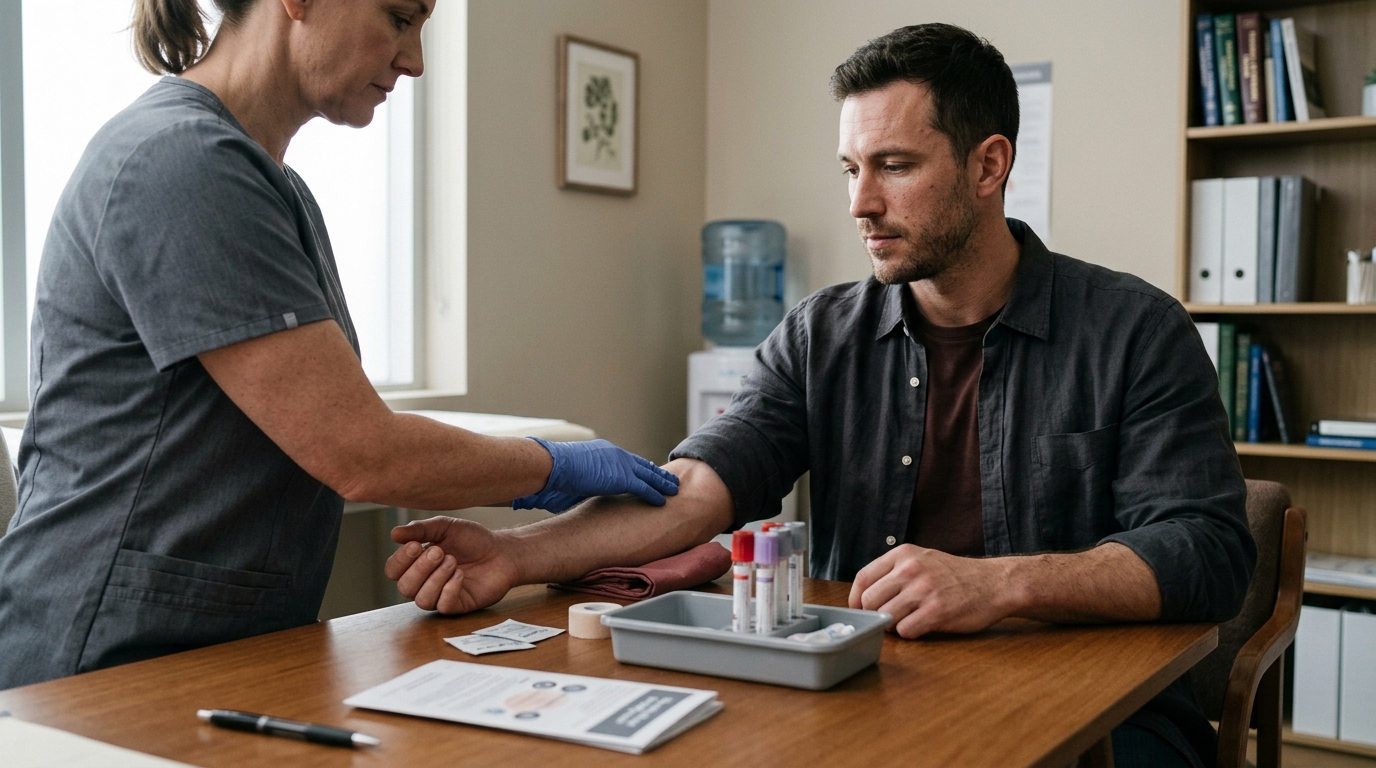
Standard laboratory protocols assume that every patient sleeps at night and wakes in the morning. When a clinician orders a total testosterone test, the standard laboratory requisition usually states that blood should be drawn between 7 a.m. and 10 a.m. For a shift worker, following this rule without context can lead to misdiagnosis.
Major medical guidelines offer different approaches to this challenge:
The Canadian recommendation accounts for the biological reality of sleep-linked hormone production. Measuring hormone levels within three hours after waking captures the post-sleep peak, regardless of whether that waking occurred at 6 a.m. or 4 p.m.
If you work non-standard hours, consider how these scenarios affect blood collection:
If you work steady night shifts and sleep from 8:30 a.m. to 4:30 p.m. an 8 a.m. test occurs at the end of your waking day. Your testosterone is likely at its lowest point. Testing within three hours of your afternoon waking time provides a far more accurate assessment of your peak hormone levels.
If your schedule rotates weekly between days and nights, scheduling a test requires careful planning. Testing during a transition day when you slept only three or four hours will likely produce a suppressed result. It is generally better to test on a stable day off or during a run of consistent shifts after a full rest period.
The Endocrine Society recommends fasting tests because glucose and meals can acutely decrease circulating testosterone by up to 25%. However, fasting for an afternoon blood draw after waking from daytime sleep can be logistically challenging. You should discuss with your clinician whether you should fast for eight hours prior to waking or simply avoid eating between waking and the blood draw.
For an extensive review of blood collection protocols, explore our guide on testing biomarkers and interpreting diagnostic panels.
A laboratory value is only one part of a comprehensive clinical evaluation. A single number never constitutes a medical diagnosis. Clinicians interpret lab results within the broader context of your physical health, medical history, and daily symptoms.
Hypogonadism is a clinical diagnosis defined by two mandatory elements:
Symptoms play a central role, but they are notoriously non-specific in tired workers. Chronic fatigue, reduced physical endurance, difficulty concentrating, low motivation, and irritability can all stem directly from shift work sleep disorder. These same complaints are classic symptoms of low testosterone.
When an overtired shift worker presents with fatigue and receives a single low morning test result, it is tempting to blame hormones. In many cases, the low test result simply reflects poor sleep timing or acute sleep restriction before the test. If that individual receives hormone replacement therapy without addressing their sleep, their underlying exhaustion and health risks remain unmanaged.
Clinicians must evaluate several contributing factors before reaching a diagnosis:
Before concluding that a shift worker has primary or secondary hypogonadism, healthcare providers typically investigate whether improving sleep hygiene and stabilizing test conditions resolves the low values. Repeat testing under rested conditions is essential to avoid unnecessary life-long treatment protocols.
Read our detailed overview on low testosterone signs and causes to understand how underlying health conditions influence symptoms.
To interpret hormone science accurately, you must distinguish between high-quality clinical trials, small laboratory studies, and observational surveys. Much of the popular discussion around sleep and hormones relies on oversimplified interpretations of limited research.
The most frequently cited study demonstrating that sleep loss lowers testosterone was conducted by Eve Van Cauter and Rachel Leproult in 2011. This study investigated 10 healthy young men with an average age of 24.3 years.
The protocol was tightly controlled:
The results showed that after one week of five-hour sleep nights, average daytime testosterone levels between 8 a.m. and 10 p.m. dropped from 18.4 nmol/L to 16.5 nmol/L. The decline was most pronounced between 2 p.m. and 10 p.m. where levels fell from 17.9 nmol/L to 15.5 nmol/L, representing a 10% to 15% reduction. The participants also reported progressive declines in self-reported vigor and mood.
While this study is methodologically rigorous, its limitations must be recognized:
Studies examining real-world shift workers show far more variable results than controlled laboratory trials. While some small field studies have reported lower total testosterone in night workers, broader systematic reviews find no consistent reduction in 24-hour mean concentrations.
Many field studies suffer from critical design flaws:
In summary, the strongest evidence confirms that acute, severe sleep restriction temporarily suppresses daytime testosterone. However, current evidence does not prove that working night shifts automatically causes permanent endocrine failure.
For more evidence summaries on health and lifestyle factors, review our collection of research resources and clinical guides.
When assessing a shift worker for suspected hormonal imbalances, clinicians look beyond total testosterone alone. A comprehensive laboratory workup includes multiple biomarkers that help differentiate between testicular dysfunction, pituitary signaling issues, and sleep-related artifacts.
Total testosterone measures the entire amount of hormone circulating in your bloodstream. Most of this testosterone is tightly bound to sex hormone-binding globulin or loosely bound to albumin. Only a tiny fraction circulates in an unbound state. Total testosterone is the initial screening biomarker, but its levels can fluctuate significantly based on hydration, acute illness, and sleep duration.
Free testosterone represents the 1% to 3% of hormone that is completely unattached to carrier proteins. Bioavailable testosterone includes free testosterone plus the portion loosely bound to albumin, which can easily dissociate and enter target tissues. Measuring free testosterone using equilibrium dialysis or calculating it from total testosterone and SHBG is valuable when binding protein levels are abnormal.
SHBG is a glycoprotein produced by the liver that binds tightly to testosterone and estradiol. Alterations in sleep, metabolic health, and diet can change SHBG concentrations. Insulin resistance, common among shift workers with irregular eating patterns, lowers SHBG. Low SHBG reduces total testosterone numbers while free testosterone may remain relatively normal.
The pituitary gland secretes LH and FSH in pulses to stimulate the testes. LH instructs Leydig cells to produce testosterone, while FSH supports spermatogenesis.
Prolactin is another pituitary hormone that exhibits a strong circadian and sleep-linked rhythm. Prolactin levels naturally rise during sleep and fall during wakefulness. Severe sleep disruption, chronic stress, or prolactin-secreting pituitary adenomas can elevate prolactin levels. Significantly high prolactin directly suppresses gonadotropin-releasing hormone, leading to reduced LH release and lower testosterone.
Explore our dedicated section on lifestyle and natural testosterone support to understand how metabolic health influences these biomarkers.
Shift workers cannot always change their working hours, but they can adopt evidence-based environmental and behavioral practices to protect their sleep quality. The Centers for Disease Control and Prevention recommends that all adults obtain at least seven hours of sleep per 24-hour period.
National Institute for Occupational Safety and Health guidelines emphasize practical tools for shift workers to protect daytime recovery sleep.
The sleeping environment must mimic night conditions as closely as possible to support deep, restorative rest:
Light is the primary environmental synchronizer for your circadian clock. Managing light exposure helps shift workers adapt to non-standard hours:
Caffeine has an average elimination half-life of five to six hours, and its clearance can take longer in some individuals. Consuming coffee or energy drinks during the second half of a night shift directly degrades daytime sleep quality.
Workplace policies play a major role in preventing chronic sleep deficits. NIOSH guidelines suggest that workers should have at least 10 consecutive hours of off-duty time between shifts. This protected window ensures that workers have sufficient time for commuting, meals, family responsibilities, and seven to eight hours of uninterrupted sleep opportunity.
For more evidence-based approaches to daily habits, check out our resources on natural testosterone support and sleep recovery.
Preparing for a medical appointment allows you to provide your clinician with the necessary context to interpret your hormone tests correctly. Communicating details about your schedule prevents misinterpretation of your lab numbers.
When you see a healthcare provider for hormone testing, bring a concise summary of your work and sleep history:
Here are practical questions to discuss with your doctor:
If you are a shift worker concerned about your testosterone levels, take these structured steps over the next week to protect your health and prepare for medical testing:
Managing non-standard work hours requires deliberate planning. Protecting your sleep environment and timing your blood tests appropriately ensures that your medical care reflects your true hormonal health.
Testostra explains testosterone biology, testing, symptoms, lifestyle factors and TRT with careful sourcing and clear clinical limits.



Send us a question, research idea or topic suggestion. Reader questions help shape future Testostra content.
Contact Testostra