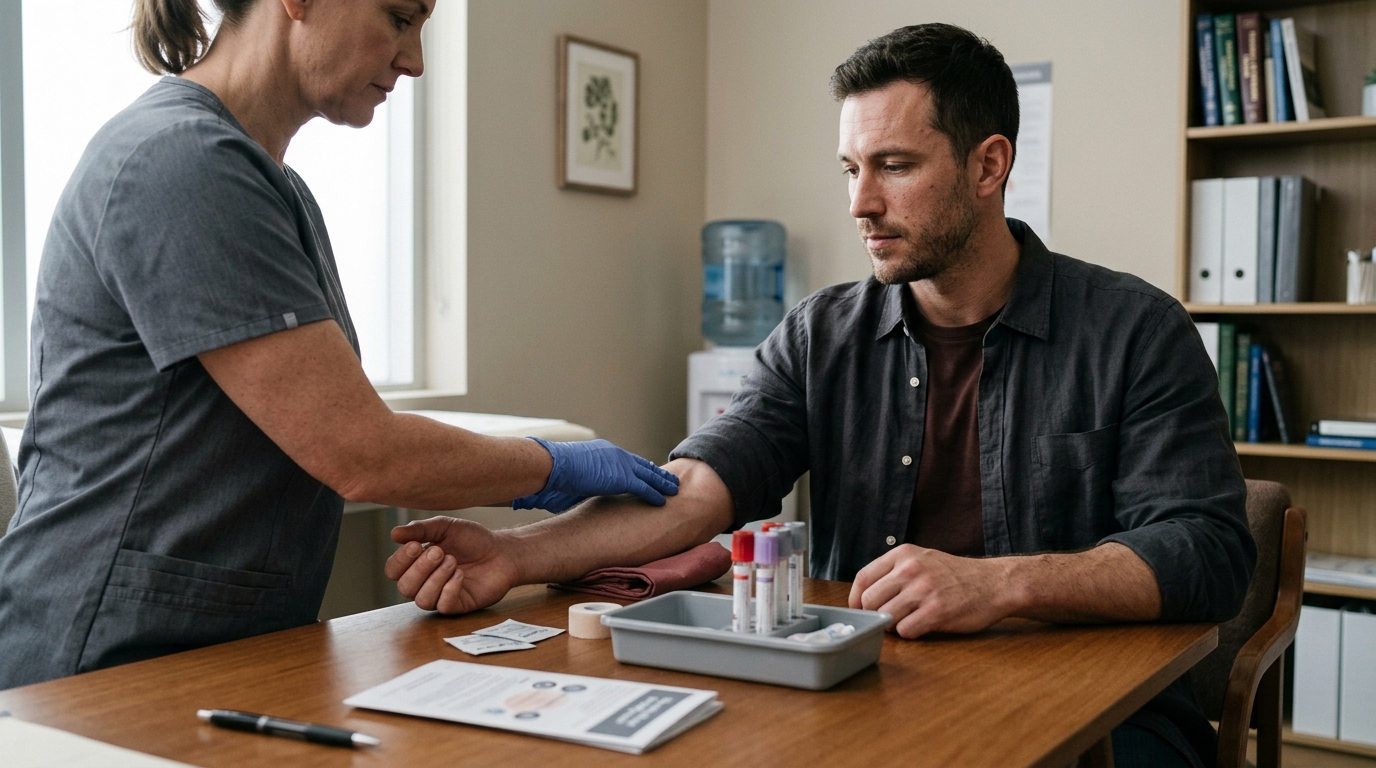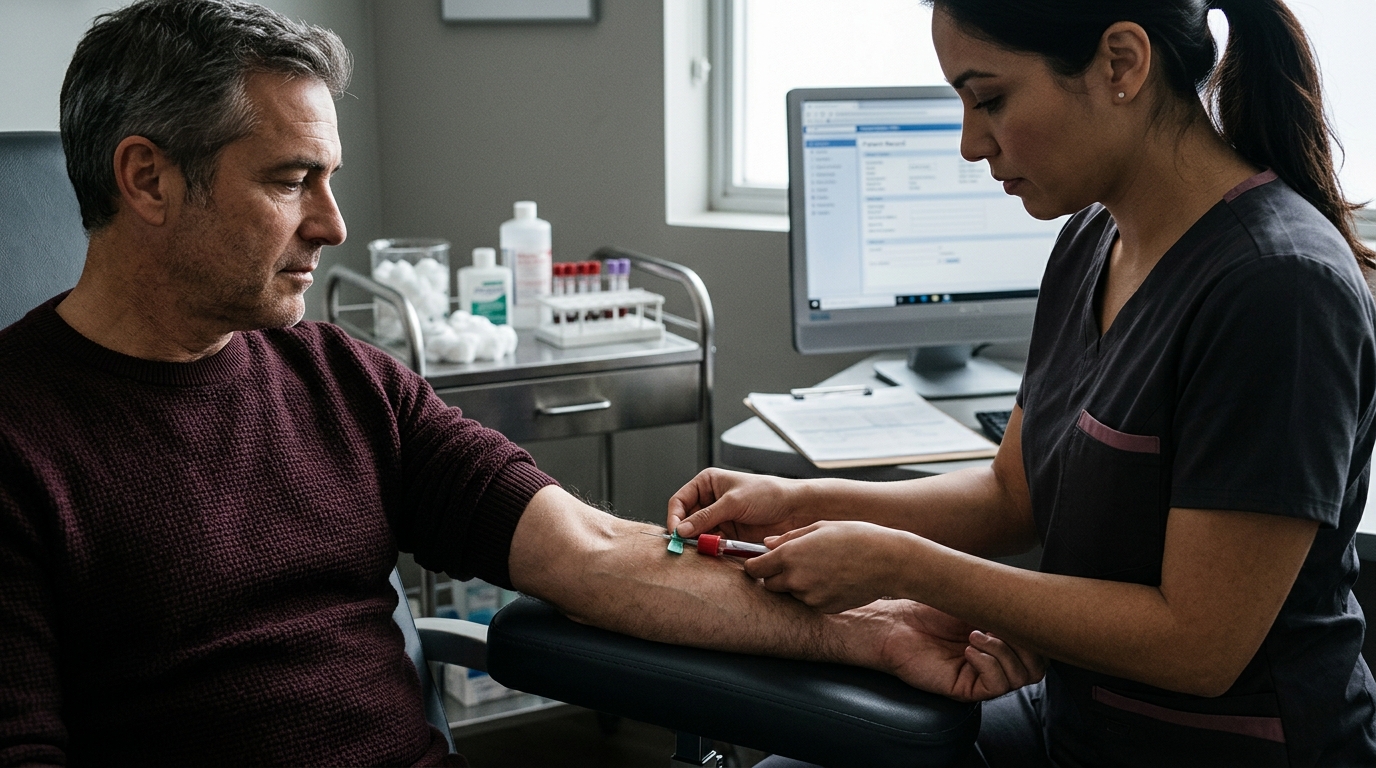

Circulating DHT is often assumed to reflect tissue androgen activity, but standard blood tests require a broader diagnostic framework for accurate clinical interpretation.





The information in this article is provided for educational purposes only. It is not intended to serve as personal medical advice, diagnosis, or treatment. Always consult a qualified healthcare professional regarding any medical condition, laboratory test, or clinical treatment plan.
Many people assume that measuring the strongest androgen in the body is the best way to assess male hormonal health. Dihydrotestosterone, or DHT, binds to the androgen receptor with significantly higher affinity than testosterone. Because of this potency, men experiencing fatigue, muscle loss, or thinning hair often believe a DHT blood test will provide definitive answers.
In clinical practice, the opposite is usually true. A serum DHT test is rarely the right starting point for evaluating common hormonal complaints. Blood levels of DHT often fail to reflect what is happening inside target tissues like the hair follicles or prostate gland. Measuring circulating DHT is only helpful in a few narrow clinical situations.
Understanding how DHT works requires a detailed look at androgen synthesis, metabolism, and laboratory science. Examining how 5-alpha-reductase converts testosterone into DHT reveals why blood tests can be misleading. It also clarifies when specialized testing is genuinely necessary.
DHT is an androgen synthesized from testosterone through the enzymatic activity of 5-alpha-reductase. This conversion occurs in specific tissues throughout the body rather than in a single central gland. The enzyme exists in distinct isoforms with different bodily distributions. Type 1 is found in many organs and is especially prominent in sebaceous glands, while type 2 dominates in genital tissues and the prostate gland.
A standard blood draw measures circulating hormones in serum. It does not measure the concentration of hormones acting inside specific cells. Mayo Clinic Laboratories notes that DHT is rapidly metabolized in the body. It also binds to sex hormone-binding globulin with very high affinity.
Because of rapid metabolism and local production, serum DHT does not accurately reflect peripheral androgen action. Clinicians evaluating peripheral androgen activity often find that downstream metabolites provide a clearer picture. For example, laboratory guidance identifies 3-alpha,17-beta-androstanediol glucuronide as a more informative marker of peripheral androgen metabolism than serum DHT itself.
This difference between circulating blood levels and tissue activity is known in endocrinology as intracrinology. Tissues produce, use, and break down DHT locally without releasing significant amounts into the bloodstream. A review of DHT biology confirms that prostate tissue can regulate DHT independently of circulating blood concentrations. Furthermore, research demonstrates that circulating DHT levels show very little correlation with skin DHT levels.
Relying on a standard blood test to judge tissue-specific androgen effects can lead to incorrect conclusions. A normal serum DHT value does not guarantee that local tissue activity is low. Similarly, an elevated serum number does not prove that a specific organ is experiencing excessive androgen stimulation. Interpreting hormone panels requires recognizing these clear biological boundaries.
When men suspect they have low hormone levels, they may wonder if testing DHT will give a more complete picture of their androgen status. Testosterone and DHT share an enzymatic pathway, but they are entirely different analytes. A serum DHT test cannot determine whether a patient has normal, low, or elevated testosterone.
The Endocrine Society provides clear, evidence-based guidelines for evaluating male hypogonadism. Diagnosis requires the presence of consistent clinical signs and symptoms paired with unequivocally low serum testosterone. Clinicians must confirm low values using accurate total testosterone assays, and free testosterone testing when indicated. Furthermore, guidelines recommend confirming results with repeat morning fasting total testosterone measurements.
DHT testing has no recognized diagnostic role in the standard workup for male hypogonadism. Testosterone levels and DHT levels do not always move in parallel. In clinical trials evaluating 5-alpha-reductase inhibitors, serum DHT fell dramatically while serum testosterone levels remained stable or increased transiently. A normal DHT result in an untreated man does not rule out testosterone deficiency.
Men researching symptoms of low testosterone should focus on validated diagnostic pathways. Ordering specialized androgen tests before establishing baseline testosterone creates confusion. Professional medical organizations emphasize accurate testosterone measurements because testosterone is the primary circulating driver of male endocrine function.
To evaluate hormone health effectively, clinicians assess overall symptoms alongside standard tests. These include morning total testosterone, sex hormone-binding globulin, and gonadotropins. Learning the basics of testosterone physiology helps patients understand why standard testosterone measurements remain the gold standard. Substituting secondary metabolites for primary diagnostic markers leads to diagnostic delays and unnecessary testing.
The most common valid reason to measure circulating DHT is monitoring the biochemical effect of 5-alpha-reductase inhibitors. Medications such as finasteride and dutasteride block the conversion of testosterone to DHT. Clinicians sometimes order a serum DHT test to confirm that the medication is suppressing DHT production as expected.
Mayo Clinic Laboratories lists the monitoring of patients receiving 5-alpha-reductase inhibitor therapy as a primary clinical indication for serum DHT testing. Patients taking these medications regularly show significant decreases in circulating DHT. A low test result in this context simply confirms the expected pharmacological effect of the drug.
Clinical trial data illustrate the magnitude of this enzymatic suppression. In comparative clinical trials, dutasteride suppressed serum DHT by approximately 94 percent compared to placebo. Finasteride suppressed serum DHT by approximately 73 percent. During these trials, serum testosterone concentrations showed a modest, transient increase because less testosterone was being converted downstream.
Documenting biochemical suppression is not the same as measuring a patient-centered clinical outcome. A suppressed serum DHT number confirms drug absorption and enzyme inhibition. However, it does not directly measure whether hair loss has stopped, whether urinary symptoms have improved, or whether side effects will occur.
Clinicians also recognize that treatment decisions should not be based solely on achieving a specific target number. A patient may experience symptom relief with moderate suppression, while another may see no change despite extensive suppression. Blood testing provides biochemical context, but clinical response remains the primary measure of treatment success.
Another established clinical application for DHT testing is the evaluation of suspected 5-alpha-reductase type 2 deficiency. This rare genetic condition impairs the body's ability to convert testosterone into DHT during fetal development and puberty. Because DHT is essential for the normal development of external male genitalia, affected individuals often present with atypical genitalia at birth.
When evaluating possible 5-alpha-reductase deficiency, measuring DHT alone is insufficient. Clinicians evaluate the relationship between testosterone and DHT using the testosterone-to-DHT ratio. This diagnostic approach compares the concentration of the precursor hormone to its downstream product.
The timing of this biochemical evaluation is critical. The testosterone-to-DHT ratio is most interpretable during periods of physiological hormone surges, such as minipuberty in early infancy or during active puberty. In prepubertal children outside these windows, baseline testosterone production is too low to assess conversion accurately. In those cases, pediatric endocrinologists use human chorionic gonadotropin stimulation testing to stimulate testosterone production before measuring the ratio.
In published clinical reviews, an elevated testosterone-to-DHT ratio of 10 to 20 or higher supports the suspicion of 5-alpha-reductase deficiency. However, this ratio serves as an initial screening tool rather than a final diagnosis. The diagnostic threshold varies depending on the patient's age, pubertal stage, and the laboratory assay used.
A normal or borderline ratio does not completely rule out an enzyme defect. Patients with partial enzyme activity, hypomorphic genetic variants, or low baseline testosterone production may not display a classically elevated ratio. For a definitive diagnosis, clinicians rely on molecular genetic testing. Identifying biallelic pathogenic variants in the SRD5A2 gene confirms the diagnosis without relying entirely on biochemical ratios.
A widespread misconception among patients is that a serum DHT test can diagnose the cause or predict the severity of androgenetic alopecia. Pattern hair loss involves genetic sensitivity of hair follicles to androgens, particularly DHT. However, this sensitivity is localized to the scalp microenvironment.
Direct clinical research demonstrates the limits of blood testing for hair loss. In a clinical study of 49 participants, researchers evaluated 28 individuals with androgenetic alopecia and 21 unaffected controls. The study found elevated serum DHT in 17 of 19 women and 5 of 9 men with hair loss. Crucially, elevated serum DHT was also present in 12 of the 21 healthy controls.
The study found no statistically significant difference in mean serum DHT levels between patients with alopecia and healthy controls. Furthermore, elevated circulating DHT levels did not correlate with the progression or clinical stage of hair loss. Medical literature continues to describe the use of serum DHT for diagnosing pattern baldness as unhelpful. A normal blood level does not rule out pattern hair loss, and an elevated level does not prove that hair loss will worsen.
A similar diagnostic disconnect occurs in prostate conditions like benign prostatic hyperplasia and prostate cancer. Both conditions are influenced by androgen stimulation within the prostate tissue. However, Mayo Clinic Laboratories cautions that patients with prostate enlargement or prostate cancer frequently show normal serum DHT concentrations.
Local enzyme activity inside the prostate maintains high tissue androgen concentrations regardless of circulating levels. Therefore, measuring serum DHT cannot determine whether a patient has prostate disease. It also cannot track the progression of prostate enlargement. Routine blood testing for DHT in these contexts provides uninformative data that can mislead both patients and providers.
When a clinician orders a DHT test for an established indication, the testing method and reference ranges require careful attention. Analytical methods for measuring steroid hormones differ significantly in their accuracy and sensitivity. Interpreting a test result requires knowing which analytical platform the laboratory used.
Advanced clinical laboratories, such as Mayo Clinic Laboratories, measure serum DHT using liquid chromatography-tandem mass spectrometry. This method uses stable-isotope internal standards and chemical extraction before measurement. Mass spectrometry provides high specificity, separating DHT from structurally similar steroid molecules that might cross-react in older tests.
In contrast, smaller studies and routine testing facilities have historically used enzyme immunoassays or radioimmunoassays. Immunoassays are susceptible to cross-reactivity with other circulating steroid hormones and metabolites. Because assay platforms differ, results from one method cannot be directly compared to results from another.
Reference intervals for serum DHT also vary dramatically based on age, sex, and developmental stage. Mayo Clinic Laboratories publishes reference intervals that illustrate this developmental progression:
Prepubertal males in Tanner stage I have reference ranges of 50 pg/mL or less. As puberty progresses, expected levels rise through Tanner stage III (80 to 330 pg/mL), Tanner stage IV (220 to 520 pg/mL), and Tanner stage V (240 to 650 pg/mL). Healthy adult males older than 19 years show an expected reference interval of 112 to 955 pg/mL.
For females, reference ranges are lower and change with age. Women aged 20 to 55 years generally show values of 300 pg/mL or less. Women over age 55 typically show upper limits of 128 pg/mL or less.
These numbers reflect specific reference populations and mass spectrometry assays. They should never be treated as universal thresholds across different laboratories. For instance, the 2014 alopecia study noted that manufacturer reference intervals were derived exclusively from a United States population. Applying reference ranges across diverse populations or different test methods can easily lead to misinterpretation.
Interpreting hormone tests requires looking at the complete endocrine picture rather than analyzing a single test in isolation. When clinicians evaluate complex complaints such as hair thinning or metabolic shifts, they follow a systematic evaluation process.
Before ordering any lab work, the clinician must establish the specific goal of the evaluation. Testing circulating DHT to check 5-alpha-reductase inhibitor compliance is clinically valid. Ordering DHT to investigate general fatigue or common pattern hair loss is not supported by clinical evidence. Defining the question prevents ordering unhelpful tests.
A thorough hormone evaluation starts with primary regulatory hormones. Total testosterone represents the total circulating concentration, while sex hormone-binding globulin determines the proportion bound to transport proteins. Free testosterone represents the unbound fraction available to diffuse into tissues.
In men with suspected androgen deficiency, luteinizing hormone and follicle-stimulating hormone help distinguish between primary testicular failure and secondary pituitary issues. Prolactin testing helps rule out pituitary prolactinomas. Exploring understanding hormone testing and biomarkers gives patients a clearer picture of how these primary markers interact.
In complex cases involving clinical signs of androgen excess, clinicians look beyond testosterone. In women presenting with severe hair loss, hirsutism, or irregular cycles, broader testing is appropriate. This workup includes total and free testosterone, dehydroepiandrosterone sulfate, androstenedione, estradiol, and thyroid-stimulating hormone.
Evaluating this complete panel provides information about adrenal and ovarian contributions to androgen production. It prevents clinicians from mistakenly attributing systemic hyperandrogenism to local DHT conversion alone.
Clinical decisions must be guided by robust medical evidence rather than preliminary findings. The diagnostic pathways for male hypogonadism and 5-alpha-reductase deficiency are supported by established clinical guidelines and molecular genetics. In contrast, using serum DHT to guide hair loss treatments is supported only by small, observational studies with significant methodological limits.
Understanding these differences in evidence quality helps patients maintain realistic expectations. When reviewing testosterone therapy research, patients should look for validated clinical outcomes rather than isolated biomarker changes. Consulting structured evidence-based testosterone resources helps readers separate established clinical standards from experimental testing.
Navigating hormone laboratory results requires open communication with a knowledgeable healthcare provider. Patients often feel overwhelmed by complex numbers, reference ranges, and conflicting information online. Preparing focused questions can make clinical consultations much more productive.
Before interpreting any hormone panel, tell your doctor about all prescription medications, over-the-counter drugs, and dietary supplements you take. Using 5-alpha-reductase inhibitors like finasteride directly lowers serum DHT.
Similarly, topical products, anabolic therapies, or herbal supplements can alter hormone pathways. Providing a complete medication history prevents providers from mistaking drug-induced suppression for a natural hormonal disorder.
To better understand your laboratory findings, consider asking your physician the following questions:
These questions encourage an evidence-based discussion focused on validated clinical guidelines. They help ensure that treatment decisions are based on accurate diagnoses rather than isolated lab numbers.
A serum DHT test is a specialized tool for narrow clinical questions, and interpreting it accurately requires evaluating the complete patient presentation rather than an isolated lab value.
Testostra explains testosterone biology, testing, symptoms, lifestyle factors and TRT with careful sourcing and clear clinical limits.



Send us a question, research idea or topic suggestion. Reader questions help shape future Testostra content.
Contact Testostra