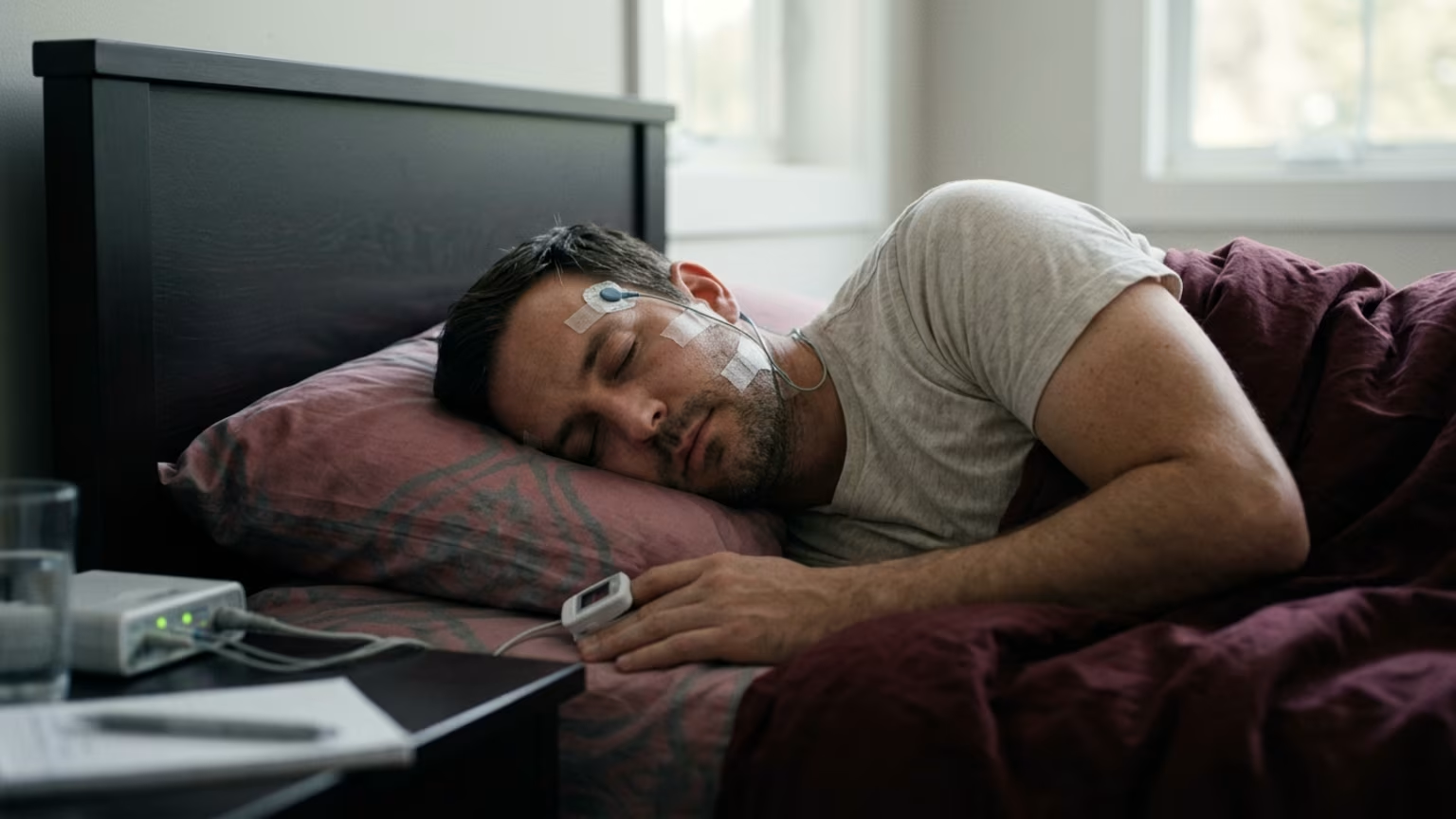

Understand sleep and testosterone research, use a sleep diary, and learn when persistent fatigue deserves clinical discussion.





How does sleep affect testosterone? A small laboratory study reported in JAMA found lower daytime testosterone in healthy young men after restricted sleep.
This article is for informational purposes only and is not medical advice. Personal symptoms and testing decisions belong with a qualified clinician.
A secondary account of the laboratory study describes an experiment involving 10 healthy young men. After a week with five hours in bed per night, their daytime testosterone was lower than under a well-rested condition. This was a controlled comparison of short-term sleep conditions, not an assessment of men seeking care for persistent fatigue.
The study’s small sample and short duration limit its application to middle-aged men or those with health conditions. Its group result does not predict an individual man’s hormone change. It also does not establish that sleep loss explains a reader’s symptoms or that more sleep would correct a low testosterone result.
The useful lesson is about interpreting evidence. An experimentally observed hormone change is a reason to consider sleep during a clinical discussion. It is not a formula for converting hours of missed sleep into an expected blood-test result.
NIH sleep guidance says adults aged 18 to 60 should get at least seven hours per night. The same guidance describes seven to nine hours as the range experts recommend. It also notes that adults sleeping less than seven hours may have more health problems.
These recommendations support taking persistently short sleep seriously for general health. They are not testosterone treatment targets. Reaching a particular number of hours does not come with a promised hormone increase.
It is also worth keeping the measurements straight. The laboratory experiment limited time in bed, while NIH guidance describes sleep duration. Those descriptions should remain distinct when comparing a study with everyday sleep habits.
For broader context, Testostra’s discussion of sleep alongside exercise and nutrition places lifestyle questions within testosterone education. The practical starting point here is a clearer account of habitual sleep, rather than choosing an hour count as a hormone goal.
A consistent schedule is reasonable sleep-health guidance, but an independent testosterone benefit is not established by this evidence. NIH advises keeping bedtime and wake time consistent, including on weekends.
That recommendation provides something concrete to assess without attaching a hormone claim to it. A review of sleep habits can consider whether bedtime stays similar across the week and whether wake time changes substantially between workdays and weekends.
A diary makes those patterns easier to describe. Instead of relying on a general impression of irregular sleep, the record can show when the schedule changes. That gives a clinician more useful information about the sleep concern itself.
The distinction matters: a habit can be worth discussing for sleep health without being a proven way to raise testosterone.
NIH recommends noting nighttime awakenings in a sleep diary. That helps turn the broad description of poor sleep into a record of what happens overnight. Duration and disruption are related questions, but they describe different parts of the sleep experience.
The evidence here does not quantify a separate testosterone effect for sleep quality. A subjective sleep rating or a wearable’s sleep-stage score should therefore not be treated as a testosterone measurement.
A more useful discussion focuses on the experience being recorded. Does sleep feel repeatedly interrupted? Are awakenings a continuing concern? Is poor sleep affecting the following day?
Those observations can help frame a clinical conversation without assigning a hormone explanation in advance. The aim is to describe the sleep problem clearly, rather than translate a sleep score into a presumed laboratory value.
NIH suggests keeping a sleep diary for a couple of weeks to help identify patterns to discuss with a doctor. Its suggested entries include:
Alongside the schedule, noting daytime tiredness and its effect on daily life can make the concern easier to explain. The record brings sleep timing and relevant habits into the same conversation. It is a practical history, not a hormone test or a diagnosis.
The diary is most useful as a description of what happened. Recording awakenings is different from deciding why they occurred. Likewise, noting tiredness does not require labeling it as a testosterone symptom.
This approach gives a clinician a starting point for questions. It also helps separate observations from assumptions: the sleep pattern is documented first, while its medical meaning remains part of the assessment.
No. Fatigue and poor sleep can have multiple explanations, so neither establishes low testosterone on its own. Their effect on daily life deserves attention without assuming that one hormone is responsible.
The Endocrine Society recommendation reproduced in a secondary clinical summary requires compatible symptoms or signs together with unequivocally and consistently low testosterone. Hypogonadism is therefore not diagnosed from tiredness alone. Symptoms and laboratory evidence need to be considered together.
This does not make fatigue unimportant. It changes the question from whether tiredness sounds like low testosterone to how a clinician should assess the overall concern.
Testostra’s explanation of placing hormone results in a wider clinical picture provides context for that distinction. A symptom deserves evaluation because it is affecting someone’s life, not because it has already been assigned a hormonal cause.
Persistent fatigue, poor sleep or repeated nighttime awakenings merit discussion with a clinician when they continue to affect daily life. NIH describes a sleep diary as a way to identify patterns that can assist that conversation and the diagnostic process.
The discussion can begin with the sleep concern itself. It does not need to begin with a request for testosterone treatment or a conclusion about why the symptoms are happening.
Useful questions include:
Bringing observations about sleep and daytime functioning keeps the conversation specific. It allows the clinician to consider the concern as a whole rather than starting with a hormone explanation that has not been established.
The same Endocrine Society guideline text calls for testosterone measurement on two separate mornings. It notes that levels vary by time of day and from day to day. It also specifies fasting measurements of total testosterone.
Those details explain why a single result is not enough to establish hypogonadism under the cited recommendation. The timing and interpretation of testing should be discussed with a qualified clinician, rather than inferred from a sleep experiment.
A sleep diary contributes a history of sleep timing and disruption. Appropriately obtained blood measurements contribute laboratory information. A clinician evaluates these alongside symptoms and signs instead of treating either record as a complete explanation.
For readers preparing that discussion, understanding why blood-draw conditions matter can clarify the purpose of a careful testing process. The goal is to understand what the result means in context, not simply to obtain a number that appears to match the symptoms.
The practical path is to document sleep habits and bring continuing problems into clinical care. Suspected testosterone deficiency belongs within an assessment that connects symptoms with appropriately repeated measurements. Sleep research helps frame questions, while the clinical process addresses what those questions mean for an individual.
Would larger and longer studies in middle-aged men show that sleep duration, schedule regularity or nighttime disruption produce meaningful changes in both testosterone and symptoms?
Choosing which sleep and testosterone concerns to raise at an appointment is where Testostra’s evidence-led explanations provide context. For men unsure whether fatigue points to a hormone problem, its coverage of symptoms and lifestyle factors helps separate research findings from assumptions about possible causes before a conversation with a qualified clinician.
Testostra follows testosterone research, clinical guidance and emerging evidence without turning general information into personal treatment advice.






Send us a question, research idea or topic suggestion. Reader questions help shape future Testostra content.
Contact Testostra