
Understand repeat testosterone testing, the EAU's low-result threshold, sampling conditions and when related biomarkers may help a clinical assessment.





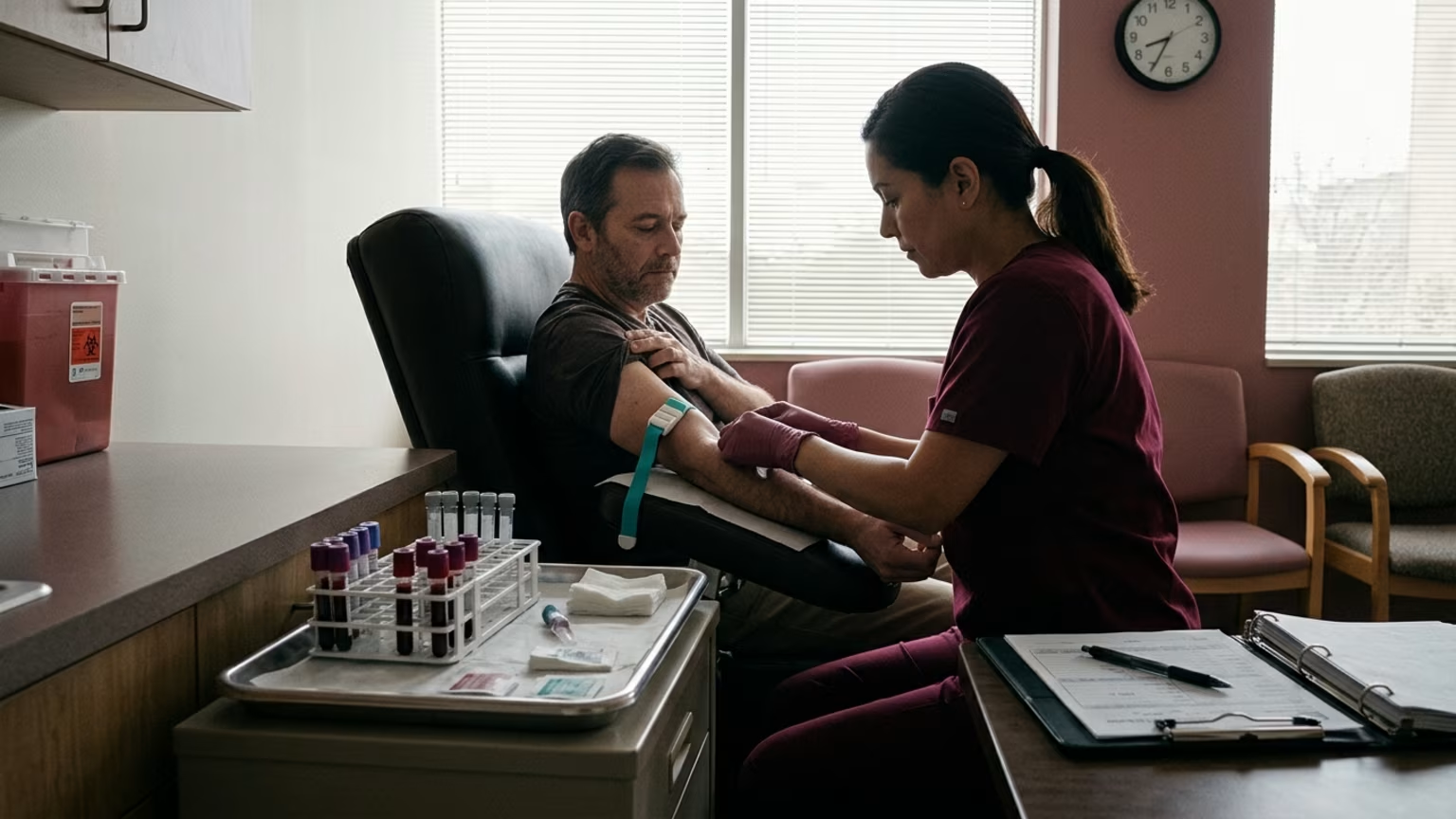
Repeat testosterone testing means measuring testosterone in separate blood samples to check whether a low result is confirmed under appropriate conditions. The European Association of Urology (EAU) bases assessment of late-onset hypogonadism on compatible symptoms or signs together with low morning total testosterone on at least two occasions. The testing conditions and measurement method matter alongside the numbers.
This article is for informational purposes and is not medical advice. A qualified clinician should interpret individual results and decide whether further testing or treatment is appropriate.
The key threshold in the EAU guidance is 12 nmol/L. The guideline recommends repeating total testosterone on separate occasions when the initial result is below this level. It also calls for confirmation of a low result before testosterone therapy.
This threshold belongs to the EAU's recommendations for late-onset hypogonadism. It is not a universal reference range that applies identically across every laboratory or clinical setting. In particular, it should not be treated as a complete interval with both a lower and an upper limit.
For an individual report, the relevant comparison includes its stated units and laboratory reference interval. A value flagged as low describes a laboratory finding. In the EAU framework, persistently low morning testosterone provides the biochemical evidence that must be considered alongside compatible symptoms or signs.
That distinction separates a concentration measurement from a diagnosis. Repeated low values do not establish the cause of a man's symptoms by themselves. Nor does the EAU framework treat a laboratory flag as sufficient evidence for treatment.
For more context on reading the report itself, see this explanation of how reference intervals fit into testosterone interpretation.
The EAU identifies LC-MS/MS as the most accurate method for evaluating sex steroids. It also notes that standardized automated immunoassays for total testosterone correlate well with LC-MS/MS. The distinction is not between one acceptable method and a claim that all other results are wrong.
Free testosterone requires a separate discussion. The EAU advises against direct free-testosterone estimates from immunoassays. It identifies equilibrium dialysis as the most accurate measurement method and describes calculation from total testosterone, SHBG and albumin as an alternative.
This means that two reports labeled “free testosterone” may require clarification about how the value was obtained. Comparing the test names alone is not enough. The clinician or laboratory can establish whether the reported measurements are meaningfully comparable.
The EAU identifies sexual symptoms as the most specific symptoms associated with late-onset hypogonadism. Low sexual desire is one symptom it considers in decisions about further hormone investigation. Symptoms still need interpretation within the broader clinical and biochemical picture.
For an adult man with reduced sexual desire, a low result is therefore part of an assessment rather than a complete explanation. The clinician considers whether the symptoms and repeat measurements fit together. The guideline also calls for investigation of diseases and other factors that may affect testosterone production or action.
It helps to keep two questions separate: Are the symptoms compatible with testosterone deficiency? And has low morning testosterone been confirmed under appropriate conditions? Neither question replaces the other.
This is why a symptom concern belongs in the same conversation as the laboratory reports. Repeating the number without discussing the clinical concern leaves an important part of the EAU assessment incomplete.
The EAU highlights several factors that affect testosterone measurement or its interpretation. Some concern physiology. Others concern what happened before the blood draw or how the sample was measured.
The EAU recommends fasting morning testing between 07:00 and 10:00. Recording the collection time makes it possible to assess whether separate results were obtained within the recommended testing conditions.
Night-shift work needs additional context. The guideline says testosterone's daily rhythm is primarily driven by sleep. For night-shift workers, it recommends fasting sampling after adequate sleep rather than applying clock time without considering the sleep schedule.
The practical discussion is therefore about both the collection time and the sleep pattern around it. This guide to sleep schedules and hormone sampling provides related context.
Fasting status can affect the result. The EAU reports that non-fasting testing can underestimate total testosterone by more than 30% in some circumstances. This is not a fixed prediction for every person or every meal.
The guideline also reviews evidence in which total testosterone and calculated free testosterone decreased within 30 minutes of oral glucose administration. These findings support attention to sampling conditions. They are not instructions to adjust a laboratory value mathematically after eating.
The EAU advises avoiding testosterone measurement during acute disease. If a sample was taken while a man was acutely ill, that circumstance belongs in the clinical review of the result.
The guideline also recommends investigating concomitant diseases that may interfere with testosterone production or action. Repeating the test and evaluating the surrounding health context are connected tasks.
Medicines and substances that may affect testosterone should be included in the discussion. The EAU recommends assessing these possible influences rather than interpreting a low value in isolation.
This is a reason to give the clinician an accurate account of what was being taken around each test. Decisions about changing a medicine belong to the prescribing clinician, not to a repeat-testing checklist.
The EAU cites a survey across 27 European countries that found differences in laboratory practices and pre-analytic protocols. These included differences in assay use and procedures before analysis.
Using the same laboratory can be a practical comparability measure. It does not mean that every laboratory change invalidates a comparison. The more useful question is whether the methods and sampling conditions are sufficiently comparable for the clinician's purpose.
The following details help turn separate reports into a useful clinical comparison:
This checklist applies the EAU's emphasis on reliable assays and appropriate sampling conditions. It is a discussion aid rather than a way to diagnose testosterone deficiency independently. A low first result obtained under unsuitable conditions is information to review, not a reason to reproduce those conditions deliberately.
The EAU establishes the need for confirmation but does not provide a universal expected amount of day-to-day change or a fixed interval between measurements. A repeat result need not match the first one exactly.
If the results differ, the useful next question is whether they were collected and measured under comparable conditions. The clinician can then consider the results alongside symptoms and decide whether another measurement would resolve a remaining question. The purpose is confirmation and interpretation, not repeating tests until a preferred number appears.
For additional context, read about reviewing variation between separate testosterone results.
When SHBG may be altered, the EAU recommends measuring SHBG and calculating free testosterone. This can be relevant when low or borderline total testosterone needs further interpretation. The calculation uses total testosterone, SHBG and albumin.
The EAU also recommends LH and FSH measurements to help distinguish types of hypogonadism. Prolactin testing is recommended in specified circumstances involving low sexual desire or signs of secondary hypogonadism.
These are targeted parts of an investigation rather than a universal panel for every isolated low result. They address a different question from simple confirmation: what additional information is needed to understand the finding? The clinician decides which measurements fit the clinical situation.
Ask your physician: “When should the result be repeated under comparable conditions, how does it fit my symptoms and the laboratory interval, and would SHBG with calculated free testosterone or other hormone tests help?”
A confirmed testing pattern still leaves questions about the other markers on a hormone report, and Testostra addresses that educational gap without making personal medical decisions. Its evidence-led coverage helps men understand total testosterone alongside free testosterone and SHBG so they can bring clearer questions about those relationships to a qualified clinician.
Testostra follows testosterone research, clinical guidance and emerging evidence without turning general information into personal treatment advice.






Send us a question, research idea or topic suggestion. Reader questions help shape future Testostra content.
Contact Testostra