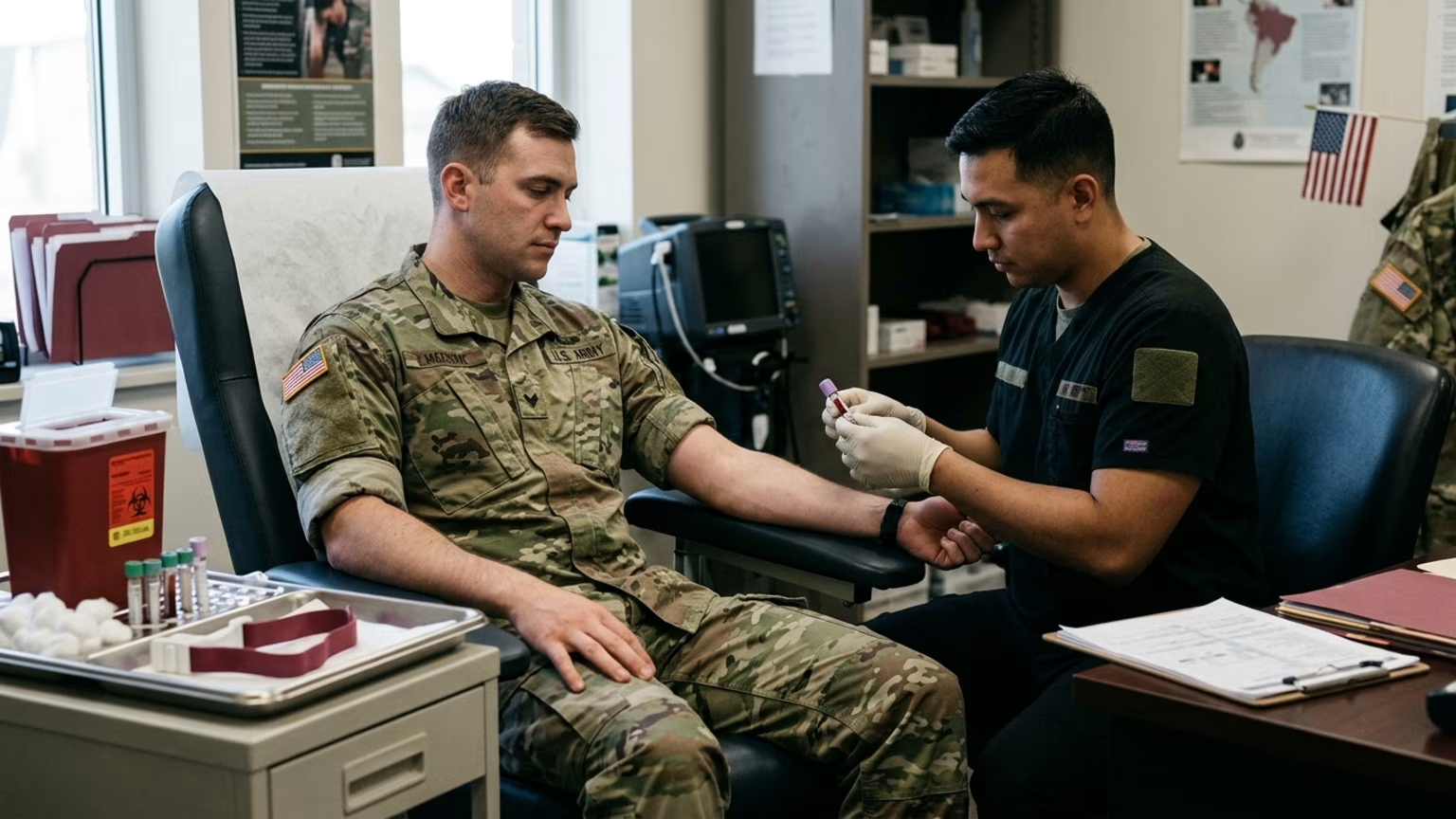

The Pentagon’s testosterone policy starts with a symptom assessment. Learn how repeat testing, physical stress and fertility fit into the evidence debate.





On September 18, 2026, the Defense Health Agency announced the Pentagon’s clinical guidance for testosterone-deficiency screening in male service members. It followed a July memorandum from Secretary of War Pete Hegseth directing screening during annual health assessments for service members age 30 and older.
This article is for informational purposes and is not medical advice. Questions about symptoms, testing or treatment belong with a qualified clinician.
DHA guidance calls for a structured symptom and risk-factor assessment for male service members age 30 and older. The assessment takes place during a periodic health assessment, entry to service or an annual physical. Men under 30 may be screened on request or when a clinician identifies clinical indicators.
The War Horse and Military.com describe a staged process rather than automatic blood testing for every eligible man. The initial assessment asks about symptoms and relevant health factors. Blood testing follows when that assessment indicates possible testosterone deficiency.
Reported symptoms include:
Reported risk factors include obesity, type 2 diabetes and sleep apnea. The guidance also considers certain medications, prior traumatic brain injury and testicular conditions. Unexplained anemia is another reported risk factor.
These are different kinds of information. A symptom describes what a person is experiencing; a risk factor provides context for the assessment. Neither is presented as a substitute for the confirmatory testing described in the guideline.
The age threshold determines who routinely receives the initial assessment. It does not mean that reaching age 30 establishes a hormone problem or automatically leads to treatment. The policy’s first decision is whether a concern warrants further medical evaluation.
Military.com’s account says the guideline requires compatible symptoms and two total-testosterone results below 300 ng/dL for diagnosis. A low result alone is not enough. The reported framework combines the clinical picture with repeated laboratory findings rather than treating either one as sufficient by itself.
ABC News and Military.com report that the blood draws should occur on separate days in the morning while fasting. Coverage describes the usual window as between 7 a.m. and 10 a.m. It also describes an adjustment for men working night or rotating shifts.
These details distinguish an initial blood result from a completed evaluation. The reported protocol does not stop after finding a low number. It calls for another measurement under specified conditions before the result becomes part of a diagnosis.
For readers trying to understand that distinction, Testostra’s explanation of why clinicians use repeat measurements provides further context. The relevant question is how symptoms and laboratory findings fit together, not simply whether one value falls below a cutoff.
ABC News reports that a second draw may include luteinizing hormone, or LH, and follicle-stimulating hormone, or FSH. It also reports that free testosterone may be checked when total testosterone is within range.
These are conditional parts of the reported evaluation rather than a fixed panel for every service member. A clinical discussion can address which measurements are being ordered and how they will be interpreted. Testostra’s guide to related biomarkers in a hormone evaluation offers background for that conversation.
The War Horse and Military.com report that the guideline calls for postponing testing for 30 days after intense training, significant sleep loss or other major physical stress. Their reporting says these conditions can temporarily suppress testosterone. The interval is intended to reduce the chance of confusing temporary suppression with persistent deficiency.
This is a distinction between a hormone measurement during physical strain and a finding that remains after recovery. In the reported protocol, the circumstances surrounding the blood draw matter alongside the number itself. Recent training and sleep history therefore belong in the medical assessment.
For civilian readers, the practical discussion concerns the context of testing rather than copying a military timetable. Relevant information includes recent illness, disrupted sleep and intense training. Testostra’s explanation of factors surrounding a testosterone blood draw provides additional educational context without setting an individual testing date.
DHA presents treatment as an option for patients and clinicians to discuss. It says treatment plans will be monitored and adjusted by military medical professionals. A positive screen is therefore not described as an automatic prescription for testosterone replacement therapy, or TRT.
Military.com reports that providers must ask about fertility intentions before prescribing. Its account says standard testosterone therapy is not to be started when a service member wants children or has not decided. The guideline describes alternative treatment pathways for those circumstances.
The treatment decision is therefore broader than whether repeated results are low. The reported process also brings future parenthood and ongoing medical monitoring into the discussion. Identifying a possible deficiency, confirming it and choosing how to address it remain separate decisions.
The guidance concerns male service members within a military health system. DHA says guidance for female service members would be issued separately. Its announcement is a clinical policy document, not a trial reporting physiological changes or measured benefits from the screening program.
DHA describes readiness and long-term health as reasons for the initiative. Those aims explain why the Pentagon introduced the policy. They do not establish that this screening approach improves military performance or that treating people identified through it improves readiness.
That distinction matters when assessing the headline question of whether the plan will help troops. The stated purpose of a program and evidence of its results are different things. The material described here establishes the screening framework rather than its eventual benefits.
The Endocrine Society says evidence is insufficient to support population-level testosterone blood screening of asymptomatic men. It warns that screening men over 30 could generate false positives and unnecessary testing or treatment. The Associated Press also reported that medical experts questioned the program’s need and efficacy.
That criticism needs to be read alongside the policy’s actual sequence. The reported military process begins with a symptom-and-risk assessment rather than a blood draw for every man. The Society’s objection to population screening does not establish that every eligible service member will receive blood testing.
The War Horse also notes that fatigue, depressed mood and low motivation can have many causes. A questionnaire cannot reliably establish testosterone deficiency on its own. These concerns support treating an affirmative screening response as a prompt for clinical assessment rather than a conclusion about its cause.
The Endocrine Society separately criticized aspects of the guideline’s approach to obesity and fertility. It said weight management should be considered and raised concerns about the recommended hCG pathway and sperm production. These are the Society’s stated objections, not uncontested findings that settle the treatment debate.
The DHA announcement confirms the screening and treatment framework but does not spell out the laboratory details in its public-facing summary. The testing threshold and draw conditions discussed above come from reporting on the guideline. That difference is important when distinguishing the agency’s announcement from detailed accounts of implementation.
The policy also went through revisions. The War Horse reports that initial guidance issued in early September was withdrawn within a day. Replacement guidance applying to male service members followed just over two weeks later.
There is a specific inconsistency in the recovery interval. The War Horse identified a 30-day interval in the guideline but a two-week interval in a separate patient information sheet. Those materials therefore do not present a single consistent waiting period.
The outlet also describes concerns about follow-up capacity, treatment monitoring, deployment continuity and occupational eligibility. These are reported implementation questions rather than established adverse outcomes. They concern what happens after screening as well as how the initial assessment is carried out.
For civilian men following this story, the useful response is a better-informed clinical conversation rather than an age-based demand for a blood test. The policy illustrates a sequence of assessment and confirmation. It does not make a questionnaire answer or an isolated laboratory value a complete explanation for a health concern.
A discussion about possible low testosterone can include:
These topics come from the reported military framework and its practical implications. They help organize information for a qualified clinician without assigning a diagnosis. They also keep the conversation focused on the person’s concerns rather than on a single numerical target.
The Associated Press describes the usual clinical approach as testing men with symptoms and confirming low levels with two blood tests. That provides a useful comparison with the reported military confirmation process. Screening policy and an individual treatment decision still require separate judgment.
The Pentagon announcement should not immediately broaden civilian testosterone testing or trigger treatment based on one result. Its reported confirmation steps reinforce careful evaluation. Decisions about an individual man’s testing and treatment remain with a qualified clinician.
Choosing whether a screening concern deserves further evaluation is a clinical decision; Testostra explains the research that informs it. Its coverage helps men distinguish questions about tiredness or sexual symptoms from conclusions about hormone deficiency, keeping uncertainty about possible causes visible without offering a personal diagnosis or a treatment plan.
Testostra follows testosterone research, clinical guidance and emerging evidence without turning general information into personal treatment advice.





Send us a question, research idea or topic suggestion. Reader questions help shape future Testostra content.
Contact Testostra