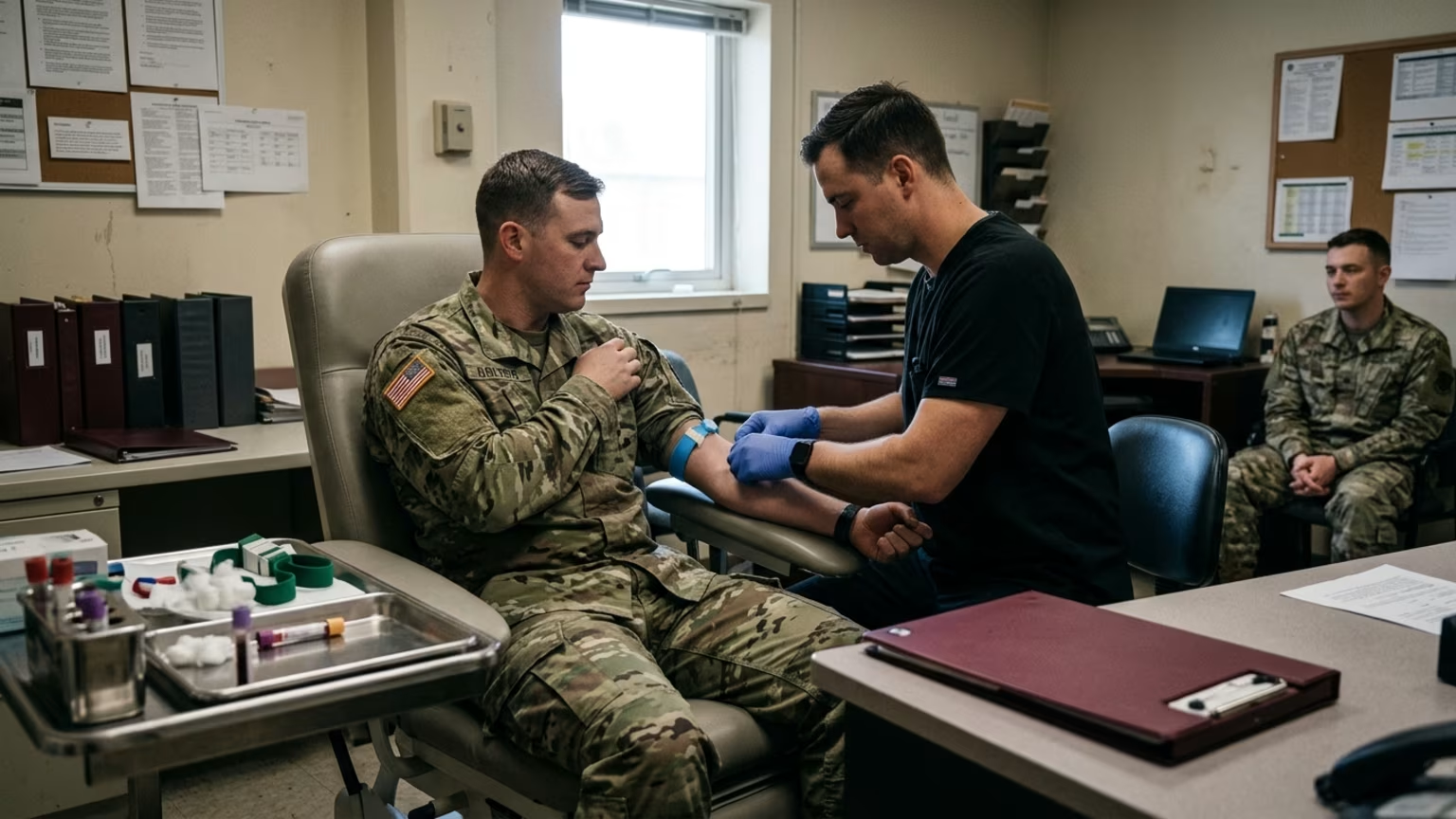

A new JAMA report on Army testosterone screening highlights age differences, cutoff choices and the need for confirmation before diagnosis.





On October 15, 2026, JAMA published a Research Letter estimating how often healthy active-duty U.S. Army men ages 19 to 39 had testosterone concentrations below the lower limit of normal.
This article is for informational purposes only and is not medical advice. Personal questions about symptoms, testing or treatment belong with a qualified clinician.
According to coverage carried by Yahoo News, the survey tested 479 male soldiers at five U.S. Army installations between August 2024 and January 2026. The reported findings came from a single morning testosterone measurement for each participant.
The Washington Post reported that 124 of those 479 men had a result below 300 ng/dL. That was about one-quarter of the sample.
The study's central measurement was therefore straightforward: how often a morning blood result fell below a specified threshold. Keeping that question in view helps separate the finding from broader questions about symptoms and treatment.
MedicalXpress reported two Army-wide screening estimates:
The two figures are not conflicting answers to an identical question. They apply different boundaries to the definition of a low screening result. Lowering the boundary changes which blood results fall into that category.
For a reader comparing headlines, the cutoff is part of the finding rather than a minor detail. A statement about the frequency of “low testosterone” needs to specify which threshold was used. Here, the difference between the estimates makes that requirement particularly visible.
Yahoo News coverage reported that about 20% of men younger than 30 had a result below 300 ng/dL. The reported rate was about 32.8% among men ages 30 and older.
Within this sample, the older age group had the higher reported rate. The study population remained men ages 19 to 39, as described by JAMA. The “30 and older” category therefore needs to be read within that age range.
The age breakdown describes how screening findings were distributed rather than treating all participants as one group. It also connects the research to a specific military policy discussion.
According to Yahoo News coverage, a Pentagon plan announced by Defense Secretary Pete Hegseth called for annual testosterone screening among male service members ages 30 and older. The report described a planned program, not evidence that all eligible service members had already completed testing.
The same coverage said the Defense Department's confirmation procedure calls for two morning fasting tests when low testosterone is suspected. That procedure is important context for interpreting the screening proposal.
At a policy level, screening and confirmation serve different purposes in the reported process. The first identifies results needing further attention. The second belongs to the medical assessment that follows.
Researchers quoted in the coverage said routine screening would likely prompt confirmatory testing and clinical evaluation for many male service members. That makes the study relevant to planning follow-up care, rather than simply counting how many tests cross a threshold.
The policy context and the research question also have different starting points. The reported plan focuses on a particular age group for screening. The survey includes both younger and older men within its study population. Keeping those two groups in view helps explain why the age comparison received attention without treating the policy itself as a study finding.
The results need to be read within several clear boundaries.
These boundaries leave an important question for an individual medical review: what does the result mean alongside the person's symptoms and further evaluation?
The immediate implication is careful confirmation and clinical interpretation, not a new reason to prescribe TRT. The Research Letter adds evidence about how frequently screening thresholds may be crossed in a defined military population. It does not introduce a new diagnostic process or establish a treatment recommendation for an individual reader.
Personal questions belong with a qualified clinician. The following topics can help keep that conversation tied to the evidence rather than to the most striking headline.
The starting point is the actual result and the cutoff used to interpret it. The study reported different population estimates under different definitions. A useful discussion therefore keeps the laboratory value separate from the label attached to it.
That does not mean choosing whichever threshold produces a preferred answer. It means understanding which question a reported number addresses before drawing a conclusion. The study's figures are best read as evidence about screening, not as instructions for selecting a personal hormone target.
Yahoo News described the Defense Department's process rather than a self-directed testing plan for readers. A qualified clinician can explain how confirmation and further evaluation apply in an individual case.
For someone with an initial low report, the central issue is what medical assessment should follow. Related explanations of interpreting a first low result and the purpose of repeat testing can help frame questions for that appointment.
The study creates a reason to ask about the relationship between a blood result and the concern that led to testing. It does not supply a personal explanation for symptoms. That question requires an individual clinical discussion, including the results of further assessment.
Reading about considering symptoms alongside blood tests can help clarify the language used in that discussion. The goal is to understand why a number attracted attention without letting it answer questions the research did not assess.
For military screening policy, the findings also point to likely demand for follow-up appointments and confirmatory testing, as the researchers noted in the coverage. That planning issue is separate from deciding who should receive long-term testosterone therapy.
Bottom line: the report supports careful follow-up under the confirmation approach already described. It should not immediately change diagnosis or treatment practice or prompt automatic TRT.
Deciding whether symptoms and a low screening result belong together is a clinician's task; Testostra makes the surrounding hormone research easier to understand. Its educational coverage addresses uncertainty about possible low testosterone symptoms by separating established clinical guidance from emerging findings, with individual diagnosis and treatment kept outside its role.
Testostra follows testosterone research, clinical guidance and emerging evidence without turning general information into personal treatment advice.





Send us a question, research idea or topic suggestion. Reader questions help shape future Testostra content.
Contact Testostra