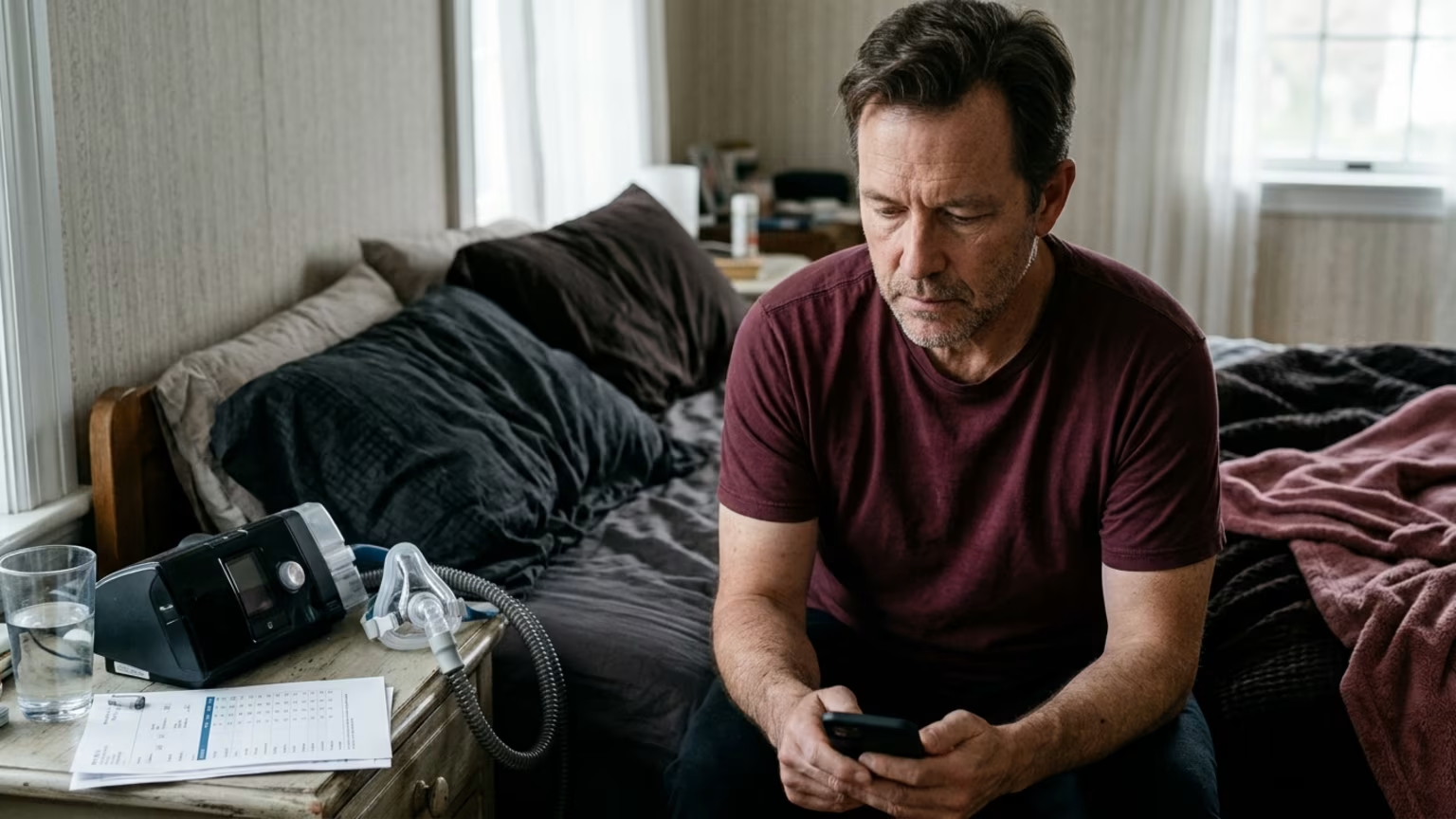

Understand sleep and testosterone study findings, the limits of catch-up sleep data, and apnea symptoms worth discussing with a clinician.





This article provides general education, not a diagnosis or an individual treatment plan. Persistent symptoms and decisions about testosterone therapy belong in a discussion with a qualified clinician.
The NHANES analysis published in Hormones was cross-sectional. That means it examined sleep patterns and testosterone within a population rather than following changes over time. It observed people's reported sleep rather than assigning them different schedules.
The authors describe modest associations that do not establish causality or support clinical use. The association with the low-testosterone category was not retained across several sensitivity analyses. These are additional analyses used to check how much a result depends on the researchers' analytical choices.
The broader findings also did not establish a relationship specific to weekend sleep extension. The authors suggest the pattern may instead reflect a mismatch between weekdays and weekends or broader sleep irregularity.
The secondary account of the laboratory experiment describes a different design. Researchers restricted sleep under controlled conditions and measured daytime testosterone. Its small group of healthy young men limits how directly the result applies to men with different ages or health backgrounds.
The CPAP finding comes through a secondary clinical review reporting the pooled analysis rather than through the underlying meta-analysis here. It should therefore be read as a reported review finding, not a definitive prediction of an individual's treatment response.
These studies address different questions. The laboratory experiment examined an imposed period of restricted sleep. The population analysis examined everyday sleep patterns, while the CPAP review considered a treatment outcome.
The NHANES study reported an odds ratio of 1.37, with a 95% confidence interval from 1.06 to 1.77, for its highest catch-up sleep category compared with none.
An odds ratio compares the odds of an outcome between groups. It is not a person's probability of having low testosterone. Without the underlying absolute frequencies, it should not be turned into a personal risk estimate.
This matters when a wellness headline turns a group comparison into a warning about someone's weekend routine. The useful question is what the study measured and how the groups differed. The number does not function as a screening test.
The same study reported a continuous testosterone estimate 28.90 ng/dL lower in the highest catch-up sleep category. Its 95% confidence interval ran from -46.96 to -10.84 ng/dL.
That estimate describes the difference in the study's statistical analysis. It does not mean a man loses that amount of testosterone when he sleeps longer on the weekend. Nor does it say where his testosterone level would sit before or after a particular night.
The cutoff of more than 1.346 hours also needs context. It defined the highest category used in this analysis. It is not a clinical boundary between an acceptable sleep schedule and a harmful one.
The laboratory finding attracts attention because a percentage change sounds easy to apply. Yet a reduction in daytime testosterone is a different outcome from a diagnosis of testosterone deficiency.
The reported 10-15% change does not supply an individual's starting level or explain the cause of his symptoms. Turning it into a fixed rule about sleep hours and hormones adds a claim the experiment did not establish.
A better reading keeps the measured outcome intact: restricted sleep was associated with lower daytime testosterone in that controlled experiment. It was not a formula for calculating a reader's hormone level.
The reported CPAP finding answers a narrower question than whether apnea deserves medical attention. A pooled analysis without a significant change in total testosterone does not make testosterone the only meaningful way to judge apnea care.
Likewise, a headline promising that apnea treatment will reliably restore testosterone goes beyond the supplied evidence. Evaluation of breathing symptoms and interpretation of hormone concerns are related clinical tasks, but they are not interchangeable.
For an adult man trying to understand fatigue, the practical starting point is the symptom pattern rather than the most striking percentage. The research supports bringing sleep concerns into a clinical conversation. It does not support choosing a hormone explanation from tiredness alone.
“Why am I tired?” and “Do I have low testosterone?” are different questions. Fatigue can occur among the reported manifestations of sleep-disordered breathing as well as other conditions. The symptom deserves attention without being assigned a cause in advance.
It helps to distinguish the concern from the conclusion. Persistent fatigue is something to report. A claim that fatigue proves low testosterone is a diagnostic leap.
Testostra's discussion of how symptoms fit into a hormone assessment provides related context. The aim is to describe what is happening clearly enough for a clinician to assess it.
The research identifies several sleep-related signs worth mentioning when discussing whether apnea should be evaluated:
These clues are reasons for a conversation, not a diagnosis by themselves. A bed partner's account of breathing pauses or repeated gasping is especially useful context to share. It adds information beyond a general description of low energy.
The point is not to decide whether a person has apnea from a list. It is to avoid leaving nighttime breathing concerns out of a consultation focused on fatigue or hormones.
A weekend sleep pattern is not a substitute for a hormone assessment. Neither is a percentage taken from a laboratory experiment. Describing sleep habits and discussing hormone results serve different purposes in a clinical review.
For readers already looking at laboratory reports, understanding hormone measurements in context is a separate educational task. A sleep history adds context rather than providing a numerical correction to a testosterone result.
There is no supported calculation here that converts missed sleep into a personal hormone deficit. The practical value of the research is in framing better questions, not adjusting a result at home.
For men considering testosterone replacement therapy, the apnea question has a specific clinical boundary. The secondary clinical review reports that the Endocrine Society advises against starting testosterone in men with untreated severe obstructive sleep apnea.
Each part of that wording matters. The caution concerns starting testosterone and a particular condition: untreated severe obstructive sleep apnea. It is not a statement that every man who snores has apnea or that suspected apnea establishes a testosterone problem.
Men considering or already using testosterone therapy should raise possible apnea symptoms with the prescribing clinician. The evidence presented here does not support changing medication independently. It supports making sure relevant sleep symptoms are part of the treatment discussion.
The next useful data would connect sleep patterns with hormone measurements over time. Longitudinal research could help establish whether changes in sleep precede changes in testosterone rather than simply appearing alongside them.
For everyday sleep patterns, watch for studies that distinguish weekend catch-up sleep from broader schedule irregularity. A more useful result would separate these questions instead of treating all differences between weekday and weekend sleep as the same exposure.
For apnea treatment, future studies should clarify both hormone outcomes and the characteristics of the men studied. That would help readers understand whom a result applies to rather than focusing only on whether a pooled average changed.
The standard for a useful update is straightforward: a clear study design, a defined population and an outcome that matches the claim being made. Until then, breathing symptoms deserve clinical attention without being turned into a shortcut to a hormone diagnosis.
When fatigue comes with nighttime breathing concerns, medical evaluation sits with the treating clinician; Testostra supports the reader's understanding of the evidence. Its explanations address uncertainty about possible low testosterone symptoms so men can prepare informed questions without treating a sleep pattern as a diagnosis or a headline as medical advice.
Testostra follows testosterone research, clinical guidance and emerging evidence without turning general information into personal treatment advice.





Send us a question, research idea or topic suggestion. Reader questions help shape future Testostra content.
Contact Testostra