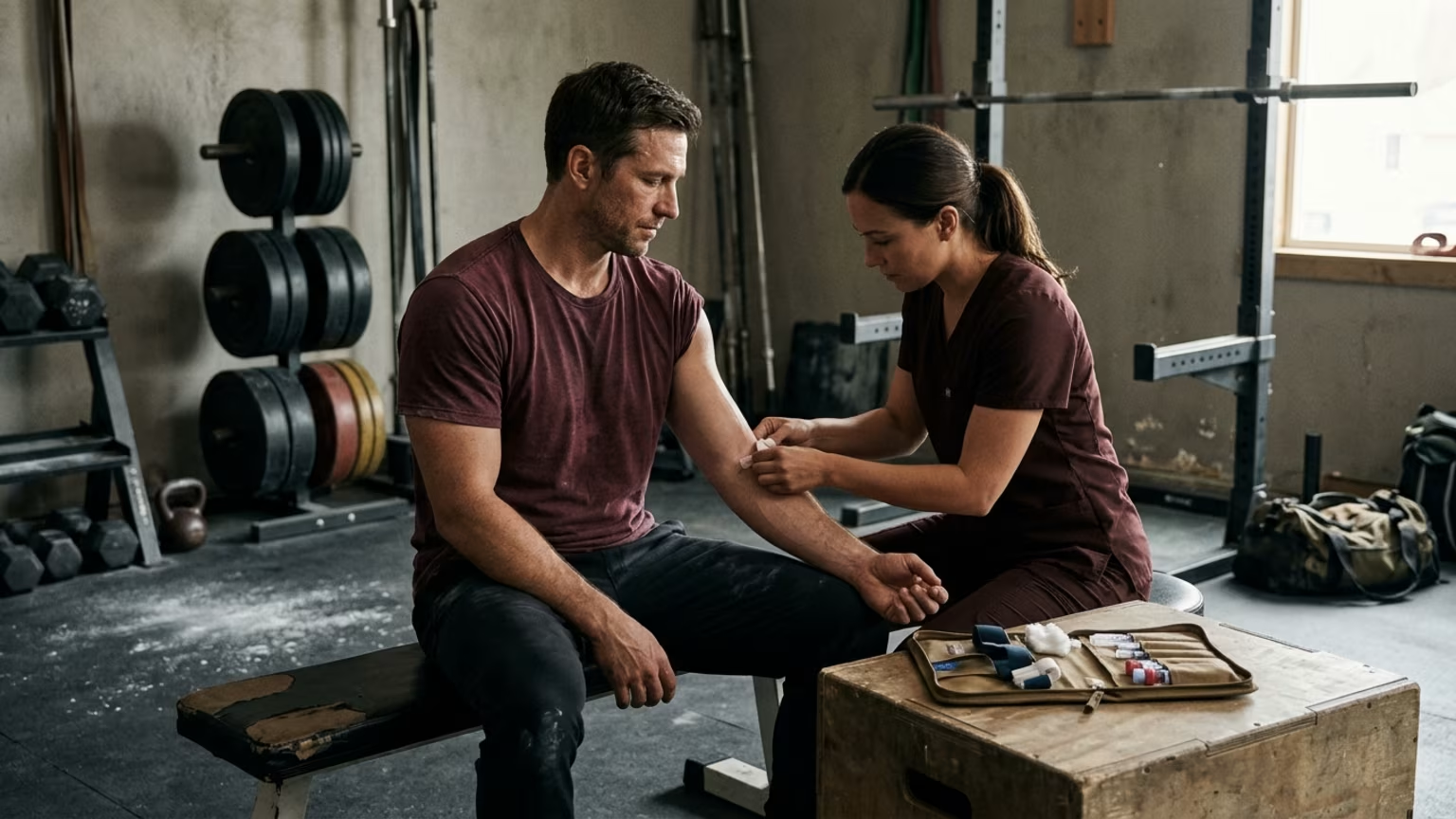

Resistance training improves strength and muscle, but a lasting testosterone rise is not assured. Understand the evidence and the role of clinical assessment.





Myth: lifting weights reliably raises resting testosterone; in reality, resistance training improves strength and muscle size but does not reliably produce a lasting testosterone increase.
This article is for informational purposes only and is not medical advice. Personal concerns about low testosterone require assessment by a qualified clinician, including decisions about testing or treatment.
Resistance training has an established purpose that does not depend on a hormone claim: improving strength and muscle size. A summary of a British Journal of Sports Medicine network meta-analysis reports findings from 192 articles. Nearly every resistance-training prescription improved strength and muscle size compared with no exercise.
That finding supports a straightforward message: strength work is worthwhile for the outcomes it directly improves. A training program does not need to raise resting testosterone to have a useful purpose. Its strength and muscle outcomes deserve to be assessed on their own terms.
It also matters which outcome a claim describes. Strength, muscle size and resting testosterone are separate measurements. Evidence showing improvement in the first two does not automatically establish improvement in the third.
For someone deciding whether lifting is worthwhile, this distinction removes an unnecessary condition. Training does not have to function as a hormone intervention to justify the effort. The established strength and muscle benefits already provide a reason to train.
The right question is therefore not simply whether resistance training “works.” It is whether it works for the specific outcome being promised.
A summary of a meta-analysis of 11 randomized trials reports no effect of exercise training on resting testosterone in insufficiently active men. The finding covered both aerobic and strength-based training.
A separate summary of a meta-analysis involving 22 studies reports results in men aged 60 and older. Resistance training did not significantly change resting testosterone. Aerobic and interval training were reported to produce small increases.
These findings do not support selling resistance training as a dependable way to raise resting testosterone. They also do not erase the strength and muscle benefits described in the larger training analysis. The studies are answering different questions.
The practical distinction is between selecting exercise for a demonstrated fitness outcome and selecting it for a promised hormonal result. The former has a clear evidence base for resistance training. The latter requires more than a general statement that exercise is beneficial.
An immediate response to a workout and a lasting change in resting testosterone are different outcomes. A measurement taken around an exercise session addresses a short-term response. A claim about higher resting testosterone concerns levels beyond that immediate workout period.
The reviewed evidence does not establish that a short-term workout-related rise becomes a sustained increase in resting testosterone. That missing link matters whenever an exercise claim uses a brief hormone response to promise an ongoing hormonal benefit.
Keeping temporary workout responses separate from baseline changes helps prevent one type of measurement from standing in for another. A claim about lasting change needs evidence that actually measured lasting change.
This gives readers a useful way to assess the wording. If the headline promises higher baseline testosterone but the supporting finding concerns a post-workout measurement, the evidence and the promise do not match. The strength benefits of the workout remain a separate issue.
The resistance-training evidence supports a flexible approach rather than a hormone-focused routine. The research summary describes many effective prescriptions, which supports making strength work adaptable to the person rather than treating one schedule as essential.
The supported framework is broad:
These are general principles, not an individual exercise prescription. Personal training choices belong in the context of the person's health and circumstances. The research supports regular strength work without establishing a particular routine as a treatment for low testosterone.
A useful goal is to keep the purpose of the routine clear. Strength development can be assessed as a strength outcome. Muscle development can be assessed as a muscle outcome. Neither requires a promised change in a hormone blood test to become meaningful.
This approach also changes how a routine is judged. A stable testosterone result is not a direct measurement of whether strength improved. Equally, a more demanding training schedule is not automatically a better response to a concern about low testosterone.
The hormone findings have defined population boundaries. The 11-trial analysis concerned insufficiently active men. The 22-study analysis concerned men aged 60 and older. Those results should not be treated as a definitive answer for every man aged 30 to 60.
The hormone findings available here are reported through secondary summaries, with limited direct detail about the training programs. The strength analysis also had moderate to high risk of bias, and most program-to-program comparisons were not statistically distinguishable. Its highest-ranked routines therefore do not establish one universally best prescription.
These limits belong in how the findings are interpreted. They support choosing resistance training for its established outcomes while avoiding precise promises about which routine will change a particular man's testosterone.
The European Association of Urology guideline on male hypogonadism describes a small testosterone improvement in evidence concerning weight loss and regular physical activity.
That is a broader finding than a claim about resistance training alone. It should not be rewritten as proof that a lifting routine reliably raises testosterone. Evidence involving activity and weight change needs to retain that context.
The distinction is especially important when several lifestyle factors are discussed together. A finding about a broader lifestyle approach does not identify the contribution of one training component. It also does not establish exercise as a replacement for assessment of suspected hypogonadism.
Concern about low testosterone changes the question from training design to clinical assessment. The EAU guideline bases evaluation of late-onset hypogonadism on compatible signs or symptoms together with consistently low morning testosterone. A training goal or a single blood result is not enough by itself.
The guideline calls for measurements on at least two occasions using a reliable assay and fasting conditions. It specifies testing between 07:00 and 10:00. When a result is below 12 nmol/L, it recommends repeat measurements on separate occasions before testosterone therapy is started.
The stated 12 nmol/L threshold is a potential criterion for considering therapy when hypogonadal symptoms are present. It is not a stand-alone diagnosis or a reason to make a treatment decision without clinical assessment. These details describe a guideline-based evaluation, not a personal testing or treatment protocol.
Understanding how hormone measurements fit into a wider assessment helps keep a result from becoming an isolated verdict. The diagnostic question concerns symptoms and biochemical evidence together, not whether someone lifts regularly or feels satisfied with training progress.
For a man with symptoms or concerns, the useful next step is qualified assessment rather than assuming that more lifting will correct a hormonal disorder. The question of why testosterone may be low belongs in that clinical context. Training can remain a worthwhile activity without being assigned the role of diagnosis or treatment.
This also prevents fitness progress from being used to dismiss a medical concern. The EAU diagnostic framework does not use an exercise response as its deciding test. Stronger lifts and a clinical evaluation answer different questions.
Judge resistance training by its established strength and muscle benefits, require direct evidence for lasting testosterone claims, and leave suspected hypogonadism to clinical assessment based on symptoms and repeat morning testing.
Treating a lifting routine as an answer to suspected low testosterone can blur the difference between fitness goals and medical concerns, so Testostra separates training evidence from hormone claims. Its coverage helps men understand uncertainty around possible symptoms and their causes, with clear boundaries between general education and personal medical decisions.
Testostra follows testosterone research, clinical guidance and emerging evidence without turning general information into personal treatment advice.



Send us a question, research idea or topic suggestion. Reader questions help shape future Testostra content.
Contact Testostra