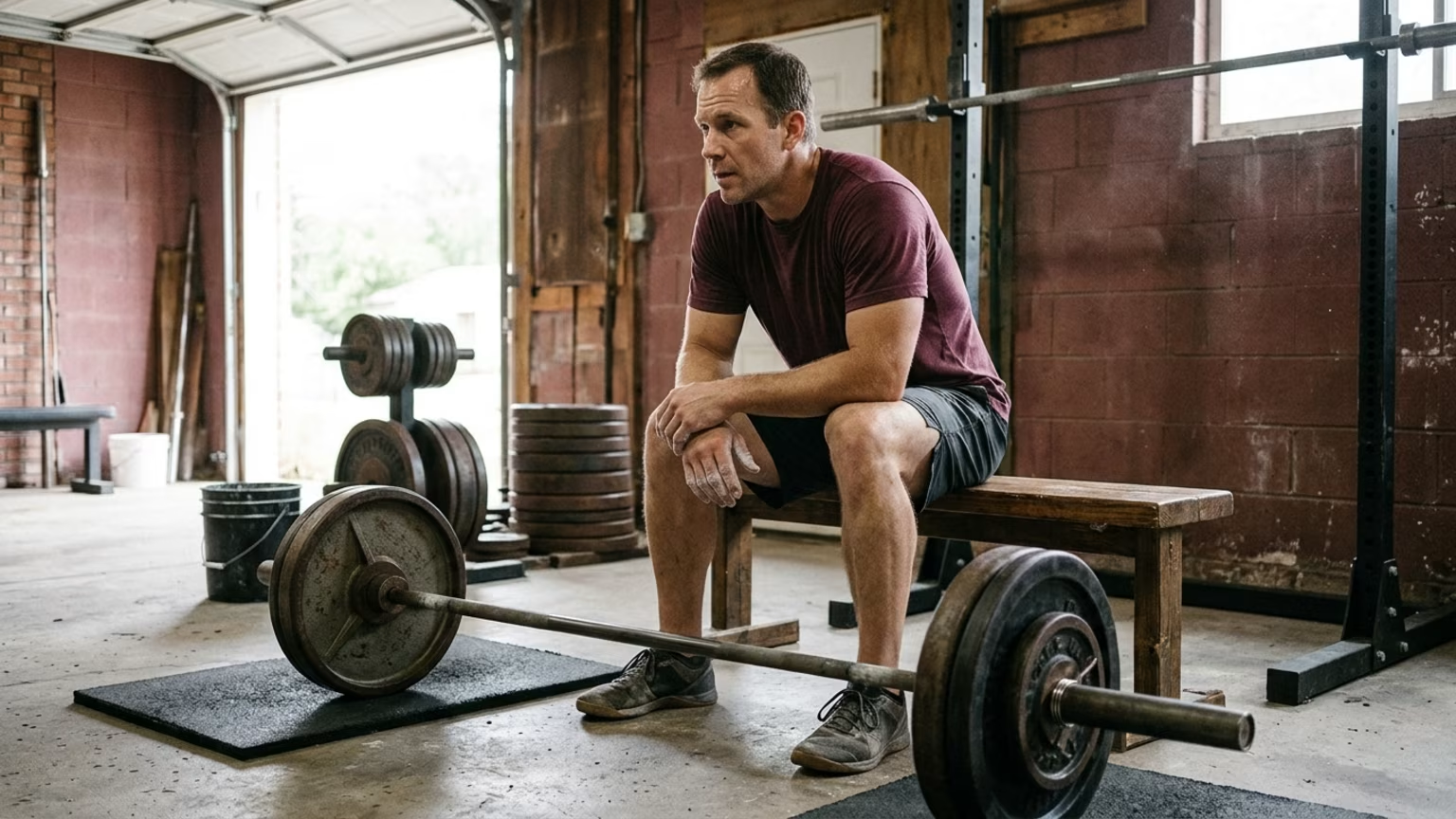

A testosterone rise after lifting is not proof of a higher baseline. Review the training evidence and why symptoms need clinical context.





Myth: a testosterone spike after lifting proves a lasting increase; in reality, an acute workout response does not establish a higher resting level.
This article is for informational purposes and is not medical advice. Questions about persistent symptoms, testosterone testing or possible treatment belong in a discussion with a qualified clinician.
A hormone measurement taken around a workout answers a different question from a resting measurement collected to assess a training program. The first concerns an immediate response to exercise. The second concerns whether the usual resting level has changed over time.
That distinction is the central issue in claims about lifting and testosterone. Evidence that a workout produces a temporary rise does not establish that repeating the workout produces a lasting increase. The lasting claim needs evidence that actually measures resting testosterone after a period of training.
Our explanation of workout responses versus longer-term changes develops this distinction. A brief response and a sustained change are not competing descriptions of the same finding. They are different outcomes that require different evidence.
A published summary of a 2021 systematic review and meta-analysis reports findings from 11 randomized trials involving 421 insufficiently active men. The exercise programs lasted a median of 12 weeks. The pooled analysis found a negligible overall effect on resting total testosterone.
According to that summary, the result did not meaningfully differ by exercise type or age. It also did not meaningfully differ by body mass status or the testosterone measure assessed in the analysis.
This is the most relevant finding when evaluating the claim that regular lifting reliably raises a man's resting testosterone. The review examined training programs rather than only measuring the immediate response to a workout. Its overall result did not support a dependable resting increase in the men studied.
The practical distinction is straightforward: evidence of a post-workout rise cannot replace evidence of a resting change. A claim about a lasting benefit needs a lasting outcome. The existence of the acute response does not fill that gap.
A secondary summary of an acute-exercise systematic review describes 15 randomized trials involving 251 participants. It reports a greater acute testosterone rise after resistance exercise than after aerobic exercise. It also describes a slower return toward baseline after resistance exercise.
Those findings concern the response around exercise. They do not contradict the negligible resting effect reported in the training-program review. A temporary rise can occur without establishing that resting testosterone has increased after repeated training.
The comparison with aerobic exercise also needs careful wording. A larger acute response means a difference in that short-term outcome. It does not establish that resistance exercise is a more effective treatment for testosterone deficiency or that it produces a higher long-term baseline.
The practical implication is to treat lifting as a pursuit of strength and physical function rather than a dependable method of raising resting testosterone. Evidence about physical performance should be judged on its own terms. It should not be treated as indirect proof that testosterone has increased.
This avoids an unnecessary choice between valuing exercise and taking the hormone evidence seriously. A negligible resting-testosterone effect does not make strength or function irrelevant. It means the hormonal claim needs to be separated from those goals.
For example, a claim about improved strength should be supported by strength outcomes. A claim about higher resting testosterone should be supported by resting hormone measurements. Neither outcome should be substituted for the other simply because both appear in a discussion of lifting.
Testostra's broader guide to training benefits beyond hormone claims keeps these questions distinct. Exercise does not need to be presented as an endocrine treatment to have a place in a discussion of physical health.
The pooled findings provide a useful answer to a defined research question. Their application still depends on who was studied, which outcome was measured and how long the programs lasted.
The main review concerned insufficiently active men. Many participants were described as apparently healthy. Its relatively short programs do not establish what happens across decades of training or in every man with a diagnosed hormone disorder.
The appropriate conclusion is therefore narrower than “exercise never changes testosterone.” The analysis found a negligible overall resting effect in the population and programs studied. It does not rule out every individual change under every circumstance.
The acute review also needs a defined boundary. Its secondary summary reports the direction of the response but does not provide precise effect sizes or a full participant breakdown. Those findings do not support a promised hormone increase or a specific training prescription for an individual reader.
These limits guide how the evidence should be used: evaluate a claim against the population and outcome actually studied. Do not turn a pooled result into a prediction for one person.
A clinical summary of a separate meta-analysis describes 22 studies focused on men aged 60 and older. It reports no significant change in resting testosterone with resistance training.
The same summary notes small increases with aerobic and interval training. However, the results varied with the testosterone measure. This older-age evidence should not be generalized to all men or treated as proof that one exercise type reliably raises resting testosterone across ages.
For a middle-aged reader, this review is relevant context rather than a direct personal forecast. It adds evidence about a specific age group. It does not erase the need to distinguish short-term responses from resting outcomes.
The European Association of Urology guideline on male hypogonadism places symptoms and laboratory findings together. Diagnosis of late-onset hypogonadism should rely on compatible symptoms and consistently low testosterone. A single isolated result is not enough.
The guideline recommends morning, fasting total-testosterone measurement. When a low result is found, it recommends confirmation with repeat testing on a separate occasion. This is a clinical assessment process rather than an interpretation of one workout-day result.
A temporary rise after lifting therefore does not show that hypogonadism has been corrected. Equally, one low result does not by itself confirm the diagnosis. The relevant question is whether symptoms and properly assessed hormone results fit together.
For men concerned about possible low testosterone, the practical next step is a discussion with a qualified clinician about persistent symptoms and testing conditions. A post-workout reading is not a substitute for that conversation. Our explanation of why confirmation matters when results change provides additional educational context.
This distinction also protects against judging a training program by an isolated laboratory number. A workout response is an exercise finding. A diagnosis requires the clinical and laboratory context described in the guideline.
A useful way to evaluate a testosterone claim is to identify exactly what the evidence supports before considering the promised benefit:
These questions do not require a reader to choose a hormone target or design a testing protocol. They help separate a supported finding from an added promise. Decisions about an individual's symptoms and results remain part of qualified clinical care.
Evaluate lifting-related testosterone claims by separating acute responses from resting outcomes, checking the population studied and leaving symptom assessment and diagnosis to a qualified clinician.
Workout hormone research leaves individual symptom questions for clinical care, while Testostra explains the evidence without turning exercise findings into personal medical conclusions. For men unsure whether low testosterone could explain their concerns, its coverage clarifies uncertainty about symptoms and possible causes so they can bring more informed questions to a clinician.
Testostra follows testosterone research, clinical guidance and emerging evidence without turning general information into personal treatment advice.



Send us a question, research idea or topic suggestion. Reader questions help shape future Testostra content.
Contact Testostra